
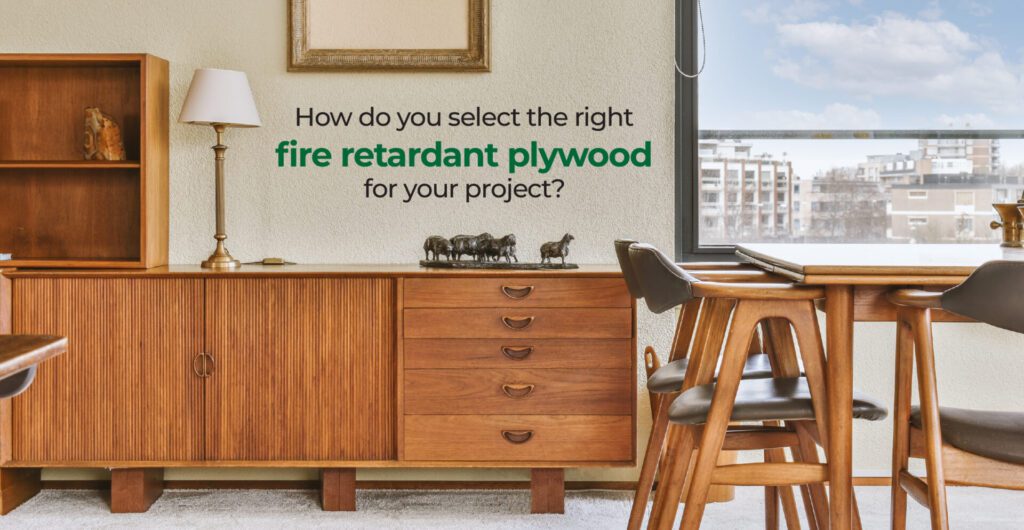
When it comes to designing or constructing modern spaces, safety is no longer optional — it’s an essential part of good design. From residential interiors to large-scale commercial projects, every material you choose plays a role in ensuring the safety and longevity of the structure. Among these, fire retardant plywood (FR plywood) has emerged as one of the most critical materials for projects where both aesthetics and safety matter.
Whether you’re designing a high-rise office, a school, or a stylish home interior, selecting the right fire retardant plywood can make all the difference. But with multiple grades, certifications, and specifications available, how do you choose the one that’s best suited for your needs?
Let’s break it down step-by-step.
Table of contents
Fire retardant plywood is specially engineered to resist the spread of fire, reduce smoke emission, and delay ignition. This type of plywood doesn’t make a space completely fireproof, but it significantly slows down the combustion process, giving people valuable time to respond in case of an emergency.
The wood veneers are treated with fire-retardant chemicals, which penetrate deep into the layers to minimize the spread of flames and prevent delamination when exposed to high temperatures. This makes FR plywood ideal for public spaces, commercial interiors, and even residential projects where safety is a top priority.
In simple terms, the chemicals used in this plywood form a protective barrier that reacts during exposure to heat. Instead of burning rapidly, the plywood chars on the surface, reducing oxygen access to the inner layers. As a result, the fire spreads more slowly, and structural integrity is maintained longer than in untreated plywood.
In today’s world of dense urban construction and tight spaces, fire safety can’t be an afterthought. Why you need to opt for fire-retardant plywood is simple: the use of FR plywood is not just recommended — in many industries, it’s mandated by building codes.
Most commercial and public buildings in India are required to meet specific fire safety standards, and the use of certified FR plywood can help ensure compliance with these norms. It’s often specified in hotels, hospitals, educational institutions, auditoriums, and multiplexes, where fire load and occupancy risks are higher.
Apart from fire resistance, good-quality FR plywood also exhibits superior resistance to moisture, termites, and warping, making it suitable for both interior and semi-exterior applications. This combination of durability and safety makes it a reliable choice for architects and contractors alike.
More than just meeting safety codes, fire retardant plywood provides peace of mind. Whether you’re building your dream home or managing a large infrastructure project, you know you’re investing in a material that prioritizes human safety without compromising aesthetics.
Not all FR plywood is created equal. The performance and reliability of the product depend on several factors. Here’s what you need to keep in mind when making your selection.
Always look for IS:5509 certification, the Indian Standard that defines the performance requirements for fire retardant plywood. A certified product ensures that the plywood has passed rigorous testing for flame spread, smoke generation, and rate of burning.
Reputable manufacturers often mention the IS certification on both the sheet and the product label — this is your first indicator of authenticity.
The quality of the wood veneers and core structure plays a big role in how effectively the plywood performs under fire exposure.
Look for hardwood-based FR plywood with uniform density and minimal voids. Cheaper softwood variants may not perform as well or may fail to retain structural stability during a fire.
The effectiveness of fire retardant plywood depends largely on how well the treatment is done. Ensure that the plywood has undergone vacuum-pressure impregnation treatment — a process where fire-retardant chemicals are deeply infused into every layer. This method provides consistent protection and long-term effectiveness, unlike surface-level coatings that wear off over time.
Reliable brands conduct periodic tests in approved laboratories to ensure compliance with safety standards. Ask for the test reports or certifications from recognized authorities to verify performance claims.
Some advanced FR plywoods even provide low smoke emission and self-extinguishing properties, both of which can be critical in enclosed environments.
Your project’s environment plays a big role in the type of FR plywood you should choose.
Once you’ve selected the right type, the benefits of FR plywood extend beyond safety alone.
The primary benefit is obvious — protection from fire hazards. FR plywood slows down flame propagation, emits less smoke, and prevents toxic fumes, providing crucial extra time for evacuation or firefighting efforts.
Unlike untreated wood that quickly weakens under heat, FR plywood maintains its bonding strength and shape longer, preventing the structure from collapsing or losing form prematurely.
Fire retardant plywood is often treated for termite, borer, and moisture resistance, giving it a longer service life. This makes it ideal for both residential and commercial interiors.
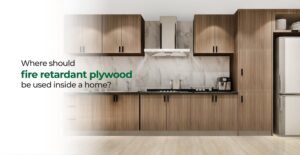
Even though FR plywood is treated for fire safety, it remains easy to finish with laminates, veneers, or paint, allowing designers to achieve any aesthetic without compromising safety. The uses of fire-retardant plywood in construction and interior design highlight its versatility, from structural elements like false ceilings and partitions in high-occupancy buildings to creative applications in wall cladding, custom furniture, and decorative paneling that blend safety with modern aesthetics.
Selecting the right fire retardant plywood is about more than meeting regulations — it’s about ensuring the safety, durability, and beauty of your space. By paying attention to certifications, treatment quality, and trusted sourcing, you can build interiors that look stunning while offering peace of mind. With a range of certified Fire Retardant Plywood from SharonPly, you get materials that combine advanced fire protection with premium craftsmanship. Each sheet is manufactured to meet IS:5509 standards, tested for durability, and designed to perform in demanding environments. When safety meets design, it’s more than just plywood — it’s a promise built to protect.


Users understand that SHARONPLY is committed to protecting the User’s privacy and shall take all efforts to protect any personal data provided to the Website by reasonable security safeguards against such risks as loss or unauthorised use, destruction, modification or disclosure of data, However, in case of any lapse, SHARONPLY shall not be held responsible for any effect or consequences thereof. The Website uses cookies to track usage of the path of the User. Since most web browsers automatically accept cookies, User can edit User’s browser options to block them if User does not want the Website to use cookies to track usage of the path of the User.
SHARONPLY undertakes not to disclose, except as otherwise provided, the personal information provided by the User to any person, unless such action is necessary to: –
By filling up any form on the Website User automatically grants SHARONPLY a royalty-free, perpetual, irrevocable non-exclusive license to use, reproduce, publish, edit, distribute, and publicly display the information given in the form and to sublicense such rights.
Any queries regarding the SHARONPLY’s privacy policy, may be sent to admin@sharonply.com.