

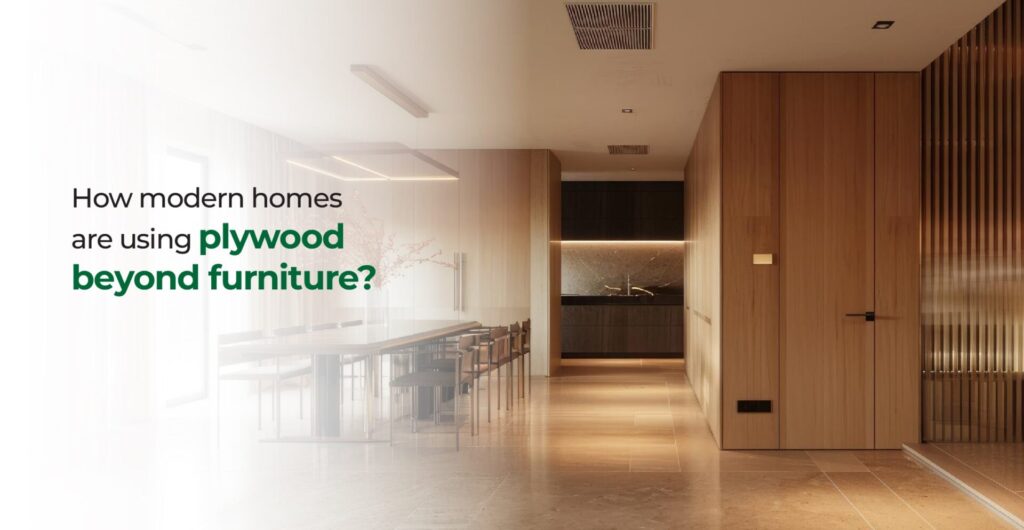
For a long time, plywood in Indian homes was associated mainly with furniture. Wardrobes, beds, kitchen cabinets and shutters were its most familiar uses. While these applications remain important, the role of plywood in modern homes has expanded significantly.
Today’s homes are planned differently. Spaces are more compact. Layouts are flexible. Interiors are expected to be functional, durable and easy to maintain. These changing needs have pushed plywood beyond furniture and into several other interior applications.
This shift is not driven by design trends alone. It is influenced by construction practices, climate considerations and the need for long-term performance.
Table of Contents
Modern interior construction demands materials that are consistent, adaptable and predictable in performance. Plywood meets these requirements when it is manufactured and used correctly.
Unlike solid wood, plywood offers uniform strength across large surfaces. Its layered construction improves dimensional stability and reduces the risk of warping when exposed to changes in temperature and humidity. This is particularly relevant in Indian conditions, where interiors experience seasonal variation throughout the year.
As homes move towards lighter construction and faster execution, plywood provides a practical balance between strength and flexibility.
One of the most visible changes is the use of plywood in wall panelling and interior partitions.
Plywood-backed panels are commonly used in living rooms, bedrooms and passage areas. They allow designers to integrate storage, lighting and decorative finishes without adding unnecessary structural load. Compared to masonry partitions, plywood-based systems are lighter and easier to modify if layouts change in the future.
This is where proper material selection becomes important. Not all plywood grades are suitable for wall applications. Core quality, bonding strength and moisture resistance influence long-term performance, especially in regions with high humidity.
Good detailing also matters. Adequate ventilation gaps and correct fixing methods help prevent moisture build-up behind panels.
Ceilings today serve more than a decorative purpose. They house lighting systems, air-conditioning ducts and service lines. In such cases, plywood is often used as a backing material or for access panels.
Plywood provides better screw-holding capacity compared to gypsum alone. This makes it suitable for removable panels that need to be opened for maintenance. Hinges and fittings remain more stable over time when fixed into plywood.
In areas exposed to heat and humidity, moisture-resistant plywood performs better and helps maintain ceiling alignment. Using the right grade reduces the chances of sagging or distortion over time.
While plywood is not commonly used as a finished flooring surface in Indian homes, it plays an important role beneath the surface.
As a subfloor material under wooden flooring, laminates or vinyl, plywood helps create a level and stable base. It distributes load evenly and reduces movement caused by foot traffic.
In home offices and media rooms, plywood is also used in raised flooring systems. These allow electrical and data cables to be routed conveniently and make future modifications easier.
Simple practices such as sealing exposed edges and protecting plywood from ground moisture significantly improve durability in these applications.
In duplex homes and villas, staircases are increasingly designed using lighter construction methods. Plywood is often used as a base layer beneath finished stair treads.
This allows for precision fabrication and cleaner detailing. It also reduces overall structural weight when compared to traditional concrete stairs.
However, staircases experience regular dynamic loads. The thickness of plywood, support spacing and fixing method all influence performance. Using appropriate grades and following recommended installation practices helps prevent issues such as creaking or deflection.
Kitchens were among the first interior spaces where plywood quality became a priority. Over time, its role has expanded beyond shutters.
Today, plywood is widely used for cabinet carcasses, drawer bases, tall units and loft storage. In these applications, core consistency and bonding quality matter as much as thickness.
Kitchens experience heat, moisture and frequent use. Choosing plywood with proper moisture resistance helps improve lifespan. Low-emission plywood also contributes to better indoor air quality, which is especially important in compact urban homes.
Industry studies have shown that interior materials can influence indoor air quality. This has made material selection a more considered decision than before.
Plywood is increasingly used in areas adjacent to bathrooms, such as vanity units and partition panels in dry zones.
Here, detailing is critical. Moisture exposure is unavoidable, but its impact can be managed through proper sealing, edge protection and ventilation. Failures usually occur at joints and cut edges rather than at the centre of panels.
Using treated plywood and following correct installation practices improves performance in these sensitive areas.
Flush doors are standard in modern homes, but plywood is also used in concealed door frames and wall-aligned door systems.
These designs require precise thickness and dimensional consistency. Even small variations can affect alignment over time. Climate conditions also influence behaviour. In drier regions, shrinkage needs to be considered, while in humid regions, swelling becomes a concern.
Matching plywood specifications to local conditions helps maintain finish quality and alignment.
While plywood is versatile, it is not suitable for every application.
It is not meant for prolonged external exposure unless specifically treated. It does not replace structural materials like concrete or steel. Its performance depends on correct selection, handling and installation.
Labour skill levels, storage conditions and on-site practices all influence outcomes. Even high-quality plywood can fail if installed incorrectly.
As materials research consistently shows, performance depends not only on the material itself but also on how it is used.
The expanding role of plywood in modern homes reflects changing construction needs and interior expectations. Its value lies in predictable performance, adaptability and efficiency.
For homeowners and professionals, the key is informed decision-making. Selecting the right grade, understanding the application and planning installation details early make a measurable difference.
At SharonPly, this approach has guided decades of product development and on-site understanding. Plywood performs best when it is specified thoughtfully and used for the right purpose. When treated as an engineered interior material rather than a generic product, it supports modern homes that remain durable, functional and reliable over time.









Users understand that SHARONPLY is committed to protecting the User’s privacy and shall take all efforts to protect any personal data provided to the Website by reasonable security safeguards against such risks as loss or unauthorised use, destruction, modification or disclosure of data, However, in case of any lapse, SHARONPLY shall not be held responsible for any effect or consequences thereof. The Website uses cookies to track usage of the path of the User. Since most web browsers automatically accept cookies, User can edit User’s browser options to block them if User does not want the Website to use cookies to track usage of the path of the User.
SHARONPLY undertakes not to disclose, except as otherwise provided, the personal information provided by the User to any person, unless such action is necessary to: –
By filling up any form on the Website User automatically grants SHARONPLY a royalty-free, perpetual, irrevocable non-exclusive license to use, reproduce, publish, edit, distribute, and publicly display the information given in the form and to sublicense such rights.
Any queries regarding the SHARONPLY’s privacy policy, may be sent to admin@sharonply.com.