
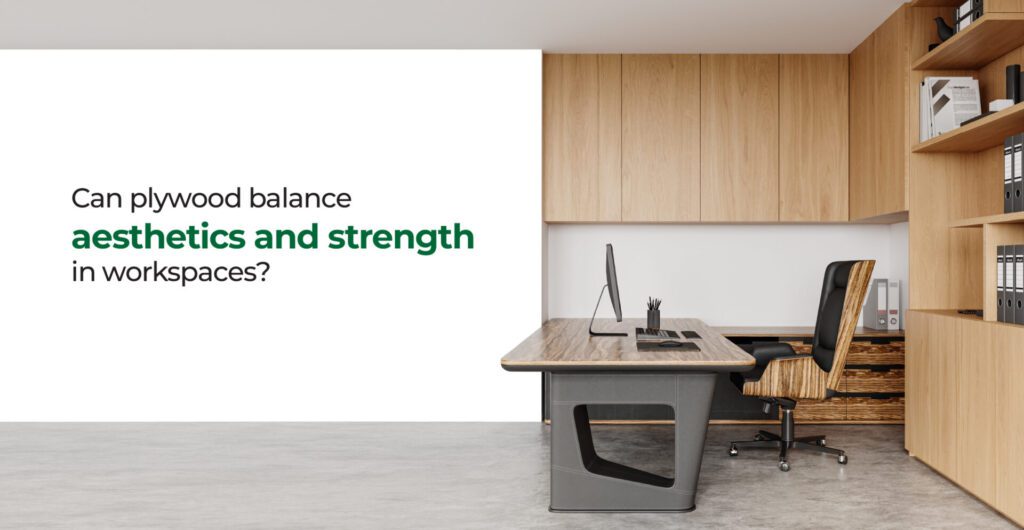
Modern workspaces need to be aesthetically appealing and at the same time it should be more functional. They should withstand the time, support daily wear and should be durable for long years. This often leads to a common question among homeowners, architects, and project teams. Can plywood really deliver both visual appeal and structural strength in workspaces?
By observing the changing dynamics of interiors in the Indian conditions, the answer is not a simple yes or no. Plywood can balance aesthetics and strength, but only when the right material is chosen, handled well and used for the right application.
Workspace interior is entirely different from residential interiors. Commercial offices, clinics, studios and institutional spaces face higher loads and longer usage than the home interior setup.
In practical use, materials must handle:
The choice of material plays a crucial role in addressing all the issues mentioned above. The base material must be stable and durable, while also enhancing the decorative appeal of the floor.
More often than not, Plywood is often judged by how it looks on the outside. External appearances like the veneer finish, laminate compatibility and smoothness get the attention while the strength and performance is assumed or overlooked.
In reality, plywood performance depends on several internal factors:
A visually attractive board with weak core bonding will not hold screws well in the long run. So it is vital to choose plywood that handles aesthetics and strength.
In general, people assume that the heavier plywood is always stronger. But it is not like that, weight of the plywood alone does not guarantee performance.
Strength comes from:
Workspaces require large storage units and partitions. In such cases, the plywood used should be evaluated for screw holding capacity and load-bearing behavior. These properties are tested under industry norms such as internal bond strength and bending strength tests.
Thicker boards generally offer better load resistance, but thickness should match application. Over-specifying increases cost without real benefit.
Designers focus more on surface finish. Veneers, laminates, and paints perform well only when the base remains stable.
Moisture and humidity have major effects in the Indian conditions. An unevenly expanding or shrinking board causes the surface finishes to crack or peel. Aesthetic distortions become evident much before structural failure can be seen.
The risk is greatly reduced when moisture-resistant grades are used appropriately. However, moisture resistance does not mean waterproof plywood. Performance still depends on:
In particular, areas adjacent to moisture-prone zones, such as workspaces, pantries, cabinets near washing facilities, or ground-floor offices, demand special attention to this aspect.
The adhesive system used in the manufacture of plywood directly influences its durability. For instance, phenol formaldehyde and similar exterior-grade resins provide better resistance to moisture and heat than interior-grade adhesives.
Industry standards like IS 710 and IS 303 clearly specify the bonding and performance parameters. These standards will allow the users to make a distinction between plywood for dry interiors and plywood for more demanding environments.
In closed workspaces, the emissions are seen as vital. Low-emission plywood is important for improving indoor air quality. Again, certification about emission levels can provide transparency, but performance will nevertheless depend on responsible installation and ventilation.
Even the best quality plywood will under perform if handled poorly on site.
Common issues seen in workspaces include:
The level of skill in carpentry greatly varies from one project to another. Clear drawings, correct hardware selection and basic handling discipline go a long way in preserving both aesthetics and strength.
In practice, well-installed mid-grade plywood outperforms the premium boards that have been mishandled.
Better materials having advantages come with the price as well. Not all places in the workspace require the same type of plywood.
For instance,
Balanced decisions reduce unnecessary expense and maintain performance. The approach is especially important in large projects where the material volume is high.
A workspace interior is supposed to endure for several years. It should require less maintenance.
The reason being, plywood, which has stable bonding and an even core, generally holds its alignment and finishes longer, reducing the frequency of repairs or refitting.
Regular checks on hinges, slides and areas prone to moisture extend their lives. No material is completely maintenance-free, but the right plywood reduces effort and cost over time.
Especially in workspace interior design, visual finish and structural performance should go hand in hand. A panel that provides long-term stability allows finishes to look as good as possible while, at the same time, structural performance supports day-to-day living, repeated fixing, and structural loading.
The long-term behaviour of plywood shows up in how well interiors stay in alignment, retain hardware, and adapt to changes in the environment. Consistent performance depends on selecting the appropriate grade, managing moisture exposure, and ensuring correct handling and installation on site.
Speaking of SharonPly, the experience in manufacturing and their applications in diverse conditions in the Indian context allows us to understand just one thing that materials chosen clearly in the planning stage will go to build workspaces that are useful, stable, and visually consistent over time.








Users understand that SHARONPLY is committed to protecting the User’s privacy and shall take all efforts to protect any personal data provided to the Website by reasonable security safeguards against such risks as loss or unauthorised use, destruction, modification or disclosure of data, However, in case of any lapse, SHARONPLY shall not be held responsible for any effect or consequences thereof. The Website uses cookies to track usage of the path of the User. Since most web browsers automatically accept cookies, User can edit User’s browser options to block them if User does not want the Website to use cookies to track usage of the path of the User.
SHARONPLY undertakes not to disclose, except as otherwise provided, the personal information provided by the User to any person, unless such action is necessary to: –
By filling up any form on the Website User automatically grants SHARONPLY a royalty-free, perpetual, irrevocable non-exclusive license to use, reproduce, publish, edit, distribute, and publicly display the information given in the form and to sublicense such rights.
Any queries regarding the SHARONPLY’s privacy policy, may be sent to admin@sharonply.com.