
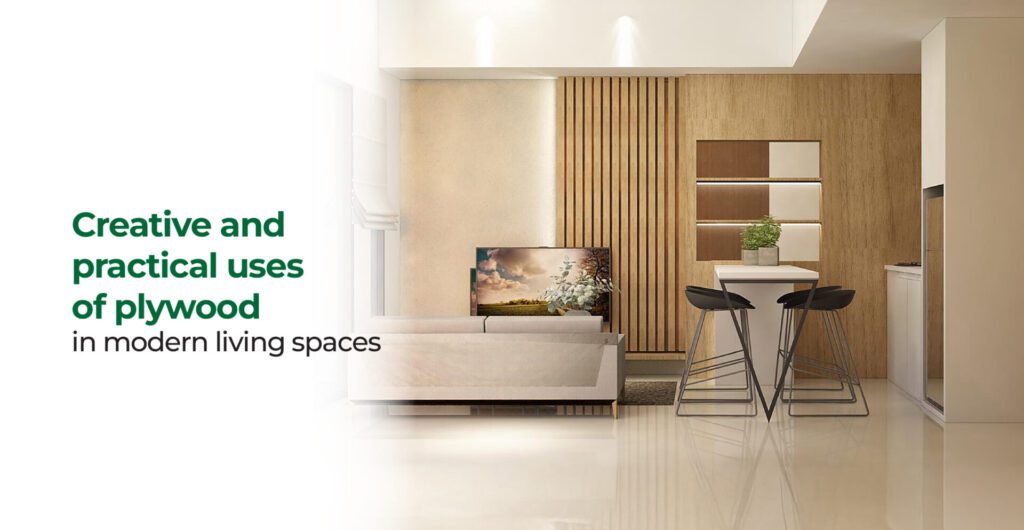
Over time, contemporary living spaces demand more from the products used within them. Maximum demands are being made on the product in terms of its ability to offer strength, flexibility, aesthetic qualities and durability.
Plywood has seen significant evolution and now goes beyond its initial functionality as an original structural panel to become an “invisible” core material in many items such as furniture, storage solutions, partitioning, and decoration.
From decades of close association with Indian families, carpenters, and project teams, one thing that becomes clear is that plywood performs best when its properties are understood and utilized appropriately. This is where the right material selection really enters the picture.
Plywood is an engineered wood product that is formed through bonding pieces of wood veneer with alternating directions. This alternating arrangement is what makes up its strength and overall stability compared to other woods.
Practically, this translates to the ability of plywood to endure warping and splitting more when subjected to daily changes in temperatures and humid conditions. For instance, in India, temperatures in different areas drastically fluctuate.
Similarly, the current technology used to manufacture plywood facilitates the control of its internal structure, bonding agents, and surface quality. Such factors affect the plywood panel in the same manner throughout the cutting, fixing, and usage cycles.
While furniture tops the list of the most common usages of plywood, over time their use has expanded.
Kitchen cabinets may represent such an example. Modern kitchens require moisture-resistant characteristics, bearing value, and interlocking accuracy. Plywood and relevant bond ratings may function well in areas of sink locations, dishwasher areas, and enclosed spaces of kitchen cabinets where moisture exposure might frequently be felt.
The effectiveness of wardrobes and storage furniture also depends on the capacity of screws to adhere to wood over a period of time. The quality of wood is also significant in this regard. Wooden panels with uniform layers of wood are less likely to develop problems of loosened screws and edges breaking, as is frequently seen with furniture after several years of use.
Particularly with modular furniture systems, thickness or flatness is important. It is essential to take advantage of the benefits of engineered wood available with plywood, instead of using natural wood pieces of various shapes.
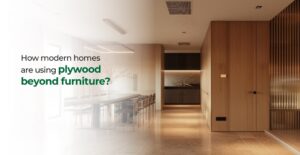
Nowadays, Plywood is no longer confined to the structural roles of housing rather it becomes an apparently intentional material, joining functional reliability with visual clarity in most modern living spaces.
One increasingly important application is that of integrated wall systems, in which a ply base supports panelling, shelving, and sometimes concealed storage in a single surface.
With decorative veneer plywood, a warm and continuous finish is achievable over large areas, while the engineered core maintains dimensional stability in both air-conditioned and naturally ventilated environments.
Plywood also allows for customized and space-efficient solutions. The built-in seating, window-side storage, and floating work surfaces benefit from plywood’s predictable behavior during cutting and fixing.
Through CNC machining, designers are allowed to introduce perforated screens, curved panels, and layered details that serve as lightweight partitions without compromising strength.
Thinner plywood panels support stepped forms, recessed lighting and continuous surfaces in ceiling features and vertical accents that are difficult to achieve with solid wood. These applications give evidence that plywood bridges structure and creativity when the right grade, core quality, and bonding technology are selected.
Doors now play a functional role as well as an aesthetic role. The contemporary plywood door has emerged as a prominent design element rather than just a functional component.
Flush doors, sliding doors, and panelled doors use the material of plywood for stability. Stable ply-based doors avoid warping better than wood-based doors; this is particularly true in areas with variable humidity.
While the appearance is enhanced with the veneered or laminated materials used for finishing, the long-term operation of a door depends on the consistency of the core material and the proper selection of its thickness.
Many people also think that the thicker the plywood, the better the performance. In reality, suitability depends on application.
On shelving, thickness should be matched to the span length and the expected load. Thinner panels with strong bonding and a uniform core will often outperform thicker panels with weak internal structure.
The grades reflect the conditions of intended use. Interior-grade plywood can be used in such dry areas as bedrooms and living rooms. Moisture-resistant grades will fare better in kitchens and utility areas. Waterproof grades are manufactured for prolonged exposure but are not needed in every interior application.
Core quality directly impacts machining, holding nails, and surface finish. Gaps or overlaps in the core result in uneven cuts and weaknesses that may eventually show up as sagging shelves or undulations in the surface.
Since the bonding is not visible, it forms the invisible backbone of plywood performance. The adhesive systems used between veneer layers determine resistance to moisture and heat, and long-term Delamination.
Under Indian conditions, when humidity levels increase sharply during monsoons, bonding stability becomes critical. Panels which perform very well under controlled factory tests may behave differently if they have been exposed to moisture during transport or site storage.
This makes handling practices important. Even the best plywood performs poorly if it is stored directly on damp floors or left exposed to rain during construction.
Plywood has been engineered to be stable, although it is not invincible.
Edge sealing, however, tends to be overlooked. Over time, the moisture gain will cause them to swell, especially around units like sink units, bathroom vanities, and furniture against the outside wall.
Carpentry skills are also a contributing factor towards this end. The spacing of furniture and materials during installation with fasteners and adhesives also increases the lifespan of plywood-based furniture. Low-quality workmanship can reduce its effectiveness regardless of its quality materials.
Generally, maintenance requirements are minimal. For instance, preventing long times of water exposure and providing ventilation around enclosed units does make a real difference over time.
Awareness of Indoor Air Quality(IAQ) has risen during the last few years. The emission rates from plywood materials depend upon adhesive systems and controls.
Plywood with low emissions is gaining favor as a material of choice for home construction, schools, and healthcare settings. While product certifications provide peace of mind, they must also be understood as part of the larger material system.
Another factor in indoor quality is finishes, laminates, and installation adhesives. The overall system also promotes health aspects in human living spaces.
Contemporary homes require clarity in material use. The comprehension of plywood utilization in furniture, walls, and contemporary plywood doors is important for its longevity.
At SharonPly, our experience working alongside designers, carpenter, and project management professionals across the nation has reinforced just one philosophy: choosing the appropriate type of plywood depending on the use, environment, and implementation helps to deliver rooms that look new and function consistently for a long time.







Users understand that SHARONPLY is committed to protecting the User’s privacy and shall take all efforts to protect any personal data provided to the Website by reasonable security safeguards against such risks as loss or unauthorised use, destruction, modification or disclosure of data, However, in case of any lapse, SHARONPLY shall not be held responsible for any effect or consequences thereof. The Website uses cookies to track usage of the path of the User. Since most web browsers automatically accept cookies, User can edit User’s browser options to block them if User does not want the Website to use cookies to track usage of the path of the User.
SHARONPLY undertakes not to disclose, except as otherwise provided, the personal information provided by the User to any person, unless such action is necessary to: –
By filling up any form on the Website User automatically grants SHARONPLY a royalty-free, perpetual, irrevocable non-exclusive license to use, reproduce, publish, edit, distribute, and publicly display the information given in the form and to sublicense such rights.
Any queries regarding the SHARONPLY’s privacy policy, may be sent to admin@sharonply.com.