
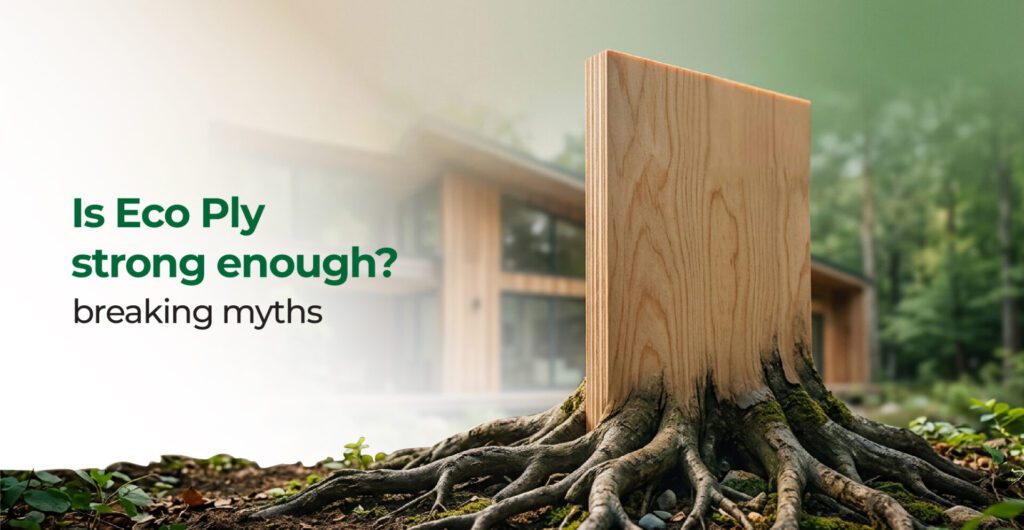
Eco ply has recently gained popularity. Many people, including homeowners and even some professionals, have asked one thing. Is eco ply strong enough for actual use?
The question has been raised because of two presumptions. First, that eco-friendly products are not strong. Second, that engineered wood alternatives are necessarily weaker than traditional hardwood-based plywood.
Strength in actual use is determined by the actual manufacturing process of the plywood. It is not determined by the name alone. Let us debunk the common myths in this blog.
Eco ply generally refers to plywood manufactured using responsibly sourced timber, plantation wood, and low-emission adhesives. It may also comply with formaldehyde emission standards such as E1 or E0 categories under European norms.
The structure, however, remains similar to conventional plywood. Multiple veneers are cross-laminated and bonded under heat and pressure. Grain direction alternates in each layer. This cross-lamination is what gives plywood its strength and dimensional stability.
So from a structural point of view, eco ply is still plywood. The difference lies in raw material sourcing and adhesive systems, not in the basic engineering principle.
Strength in plywood depends on:
If an eco ply uses properly seasoned plantation hardwood veneers and phenol formaldehyde or melamine-based adhesives suitable for the intended grade, its strength can be comparable to conventional plywood of the same grade.
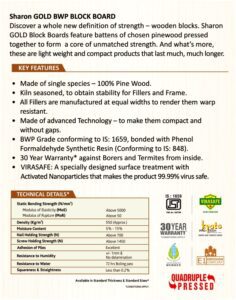
For example, a BWP grade board tested under boiling water conditions as per IS 710 standards is evaluated for bond integrity, not for whether the wood is plantation grown or natural forest sourced.
This is where material choice matters. Strength is a result of manufacturing control, not marketing terminology.
India presents real challenges. Coastal humidity, monsoon exposure, temperature fluctuations and varying site conditions all affect wood-based products.
Plywood performance depends heavily on moisture resistance and dimensional stability. Eco ply that is manufactured with moisture-resistant or waterproof bonding systems performs based on its grade, not its eco label.
For kitchen cabinets, bathrooms and utility areas, waterproof plywoods with BWP grade bonding are typically recommended. If eco ply meets these bonding standards, it can perform reliably in humid conditions.
However, climate performance also depends on storage and handling on site. Even high-grade plywood can warp or swell if left exposed to rain or stored directly on damp floors.
In practical use, proper stacking, covering and ventilation matter as much as product selection.
Core quality plays a major role in screw holding capacity and load-bearing performance.
In some lower-end products in the market, manufacturers may use mixed wood cores with gaps or filler material. This is not a function of eco standards. It is a cost-driven manufacturing compromise.
High-quality eco ply uses properly jointed core veneers, often machine-graded, with minimal core gaps. Density uniformity directly affects bending strength and fastener holding.
Over time, poor core construction becomes noticeable. Hinges loosen. Screws do not grip well. Surface laminates show unevenness.
These issues are linked to core engineering, not sustainability claims.
There is a perception that eco ply is suitable only for wardrobes or decorative panels, not for heavy-duty furniture.
Load performance depends on thickness and span. A 19 mm plywood sheet with proper cross-lamination behaves predictably under load, whether eco-certified or not.
For shelving, the span between supports must be considered. Even the strongest plywood will deflect if used over excessive unsupported lengths. This is basic structural logic.
Architects and interior designers typically refer to bending strength, modulus of elasticity and internal bond strength values when specifying materials. These parameters are influenced by veneer quality and bonding, not by whether the wood is plantation sourced.
In other words, eco ply can be specified for modular kitchens, wardrobes, partitions and office furniture, provided the correct grade and thickness are chosen.
One of the genuine advantages of eco ply lies in emission control.
Formaldehyde emissions from wood panels are regulated under various international standards. E1 classification under European norms limits formaldehyde emissions to safe indoor levels.
For residential interiors, especially bedrooms and children’s spaces, low-emission plywood reduces long-term indoor air quality risks.
This is a technical benefit, not a cosmetic one.
However, emissions also depend on surface finishes. Laminates, adhesives used for pasting, and edge sealing practices contribute to overall indoor air quality.
Material selection must be considered as a system, not as an isolated component.
Bonding technology defines how plywood behaves under stress and moisture.
MR grade plywood typically uses urea formaldehyde resin and is suitable for interior dry applications.
BWP or marine grade plywood uses phenol formaldehyde resin, which provides superior resistance to boiling water and prolonged moisture exposure.
Eco ply can be manufactured in MR, BWR or BWP grades. The grade determines application suitability.
It is important not to confuse eco positioning with water resistance performance. Always check the grade marking and certification.
Even the best plywood can under perform if mishandled.
Improper edge sealing in wet areas allows moisture ingress. Over-tightening screws can weaken the veneer layers. Poor laminate pasting techniques can cause surface bubbles.
In Indian project sites, skill levels vary. This practical reality affects long-term durability.
Good carpentry practices, correct hardware selection and proper finishing are part of overall performance.
Eco ply may sometimes carry a price difference due to certified sourcing and adhesive systems.
For large projects, cost decisions are often made based on budget targets. In such cases, it is important to evaluate lifecycle performance rather than just initial cost.
If the product offers stable performance, lower emissions and reliable bonding, the long-term value can justify the investment.
Simultaneously, not every application requires the highest grade board. For dry areas and non-load-bearing partitions, MR grade may be adequate.
Balanced material selection is always wiser than over-specification.
Yes, eco ply can be strong enough for most residential and commercial interior applications.
But the real answer is more specific.
Strength depends on grade, thickness, core quality, bonding system, storage, climate exposure and workmanship. Eco certification alone does not weaken or strengthen plywood.
When evaluated correctly against industry standards and application requirements, eco ply performs based on its engineering, not its label.
For homeowners and professionals, the key is to verify specifications, understand grading, and match the board to the intended use.
At SharonPly, with decades of experience in plywood manufacturing across Indian conditions, we have seen one consistent truth. Informed material decisions lead to durable interiors. When eco ply is engineered and specified correctly, it is not a compromise. It is a responsible and practical choice.









Users understand that SHARONPLY is committed to protecting the User’s privacy and shall take all efforts to protect any personal data provided to the Website by reasonable security safeguards against such risks as loss or unauthorised use, destruction, modification or disclosure of data, However, in case of any lapse, SHARONPLY shall not be held responsible for any effect or consequences thereof. The Website uses cookies to track usage of the path of the User. Since most web browsers automatically accept cookies, User can edit User’s browser options to block them if User does not want the Website to use cookies to track usage of the path of the User.
SHARONPLY undertakes not to disclose, except as otherwise provided, the personal information provided by the User to any person, unless such action is necessary to: –
By filling up any form on the Website User automatically grants SHARONPLY a royalty-free, perpetual, irrevocable non-exclusive license to use, reproduce, publish, edit, distribute, and publicly display the information given in the form and to sublicense such rights.
Any queries regarding the SHARONPLY’s privacy policy, may be sent to admin@sharonply.com.