
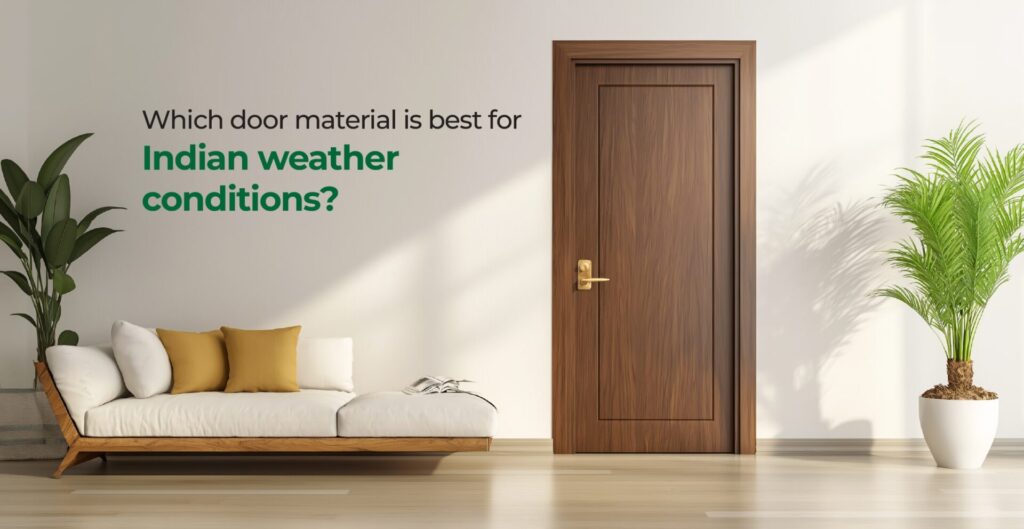
India’s climate is as diverse as its culture. From the scorching summers of Rajasthan to the humid coasts of Kerala, and from the chilly winters of the North to the monsoon-heavy cities across the country, our homes endure a lot. Doors, being the first line of protection for any living space, face these weather extremes every day.
So, choosing the right door material is not just a design decision, but it is a long-term investment in safety, durability, comfort, and peace of mind. The right material will withstand heat, moisture, pests, and daily wear, while still looking good for years. The wrong one can warp, swell, fade, crack or even become structurally weak within a short time.
Here’s a complete guide to understanding which door material performs best across India’s varied weather conditions.
Before comparing materials, it helps to understand why the Indian climate demands more from doors than many other countries. India experiences:
A good door must handle all these challenges while maintaining its structure, finish, and performance.
Solid wood has been used for centuries and remains a favourite for its natural beauty and strength. But is it suitable for India’s tough climate?
Pros:
Solid wood doors bring warmth, luxury, and sturdiness. They can be carved, polished, or customised easily. Many homeowners love their rich appearance.
Challenges in Indian climate:
Wood reacts quickly to moisture and temperature changes.
Solid wood works only when it is high quality, seasoned well, and used in areas with stable climate conditions. For coastal and humid regions, it is less reliable.
Flush doors are becoming increasingly popular in modern Indian homes due to their practical performance. Made using a solid or hollow core and covered with plywood or veneer, they are engineered for durability.
Why they suit Indian weather:
For most Indian climates—coastal regions, dry regions, and even colder zones—flush doors provide the best balance of beauty and endurance.
PVC and UPVC doors are often used in bathrooms or utility areas where moisture levels are high.
Advantages:
Limitations:
PVC doors lack the rigidity needed for main and room doors. They can fade, bend, or crack when exposed to harsh sun. They also don’t offer the premium aesthetic many homeowners desire. UPVC is stronger, but still better suited for windows and utility zones, not living rooms or bedrooms.
For internal wet areas, PVC/UPVC is fine. But for aesthetics, security, or weather resistance throughout the home, they fall short.
Metal doors are extremely strong and weather-resistant.
Pros:
Cons:
Metal doors are ideal for industrial environments, but not the preferred choice for residential aesthetics.
Fiberglass Reinforced Plastic (FRP) doors are designed to handle moisture, salt air, and heavy rain.
Strengths:
Weaknesses:
They work well for coastal cities but may not offer the elevated look architects seek for luxury homes.
Engineered wood doors combine aesthetics with high performance. These doors are made using composite cores for strength, and then finished with veneer or laminate.
Why architects love them:
Engineered doors sit at the sweet spot between beauty and durability, making them ideal for cities like Chennai, Mumbai, Delhi, Kolkata, Bengaluru, and Hyderabad that experience mixed climatic conditions.
After evaluating all options, one material consistently stands out: Flush Doors with a superior core and high-quality veneer or laminate finish.
Here’s why:
For homeowners and architects seeking reliability paired with refined style, high-quality flush doors outperform most other door materials in India’s demanding climate.
Choosing the right door material can feel overwhelming, but when you consider India’s intense climatic variations, the answer becomes clearer. A well-engineered flush door offers the stability, durability, and long-term performance that modern homes need. SharonDoor brings these advantages together with refined aesthetics, ensuring that every flush door is built to withstand humidity, heat, monsoons, and termite exposure with ease. For homeowners and architects seeking doors that stay strong, look elegant, and support comfortable living year after year, a SharonDoor is a dependable choice. As a high-quality flush door, it remains one of the most reliable solutions crafted thoughtfully for the realities of Indian weather.








Users understand that SHARONPLY is committed to protecting the User’s privacy and shall take all efforts to protect any personal data provided to the Website by reasonable security safeguards against such risks as loss or unauthorised use, destruction, modification or disclosure of data, However, in case of any lapse, SHARONPLY shall not be held responsible for any effect or consequences thereof. The Website uses cookies to track usage of the path of the User. Since most web browsers automatically accept cookies, User can edit User’s browser options to block them if User does not want the Website to use cookies to track usage of the path of the User.
SHARONPLY undertakes not to disclose, except as otherwise provided, the personal information provided by the User to any person, unless such action is necessary to: –
By filling up any form on the Website User automatically grants SHARONPLY a royalty-free, perpetual, irrevocable non-exclusive license to use, reproduce, publish, edit, distribute, and publicly display the information given in the form and to sublicense such rights.
Any queries regarding the SHARONPLY’s privacy policy, may be sent to admin@sharonply.com.