

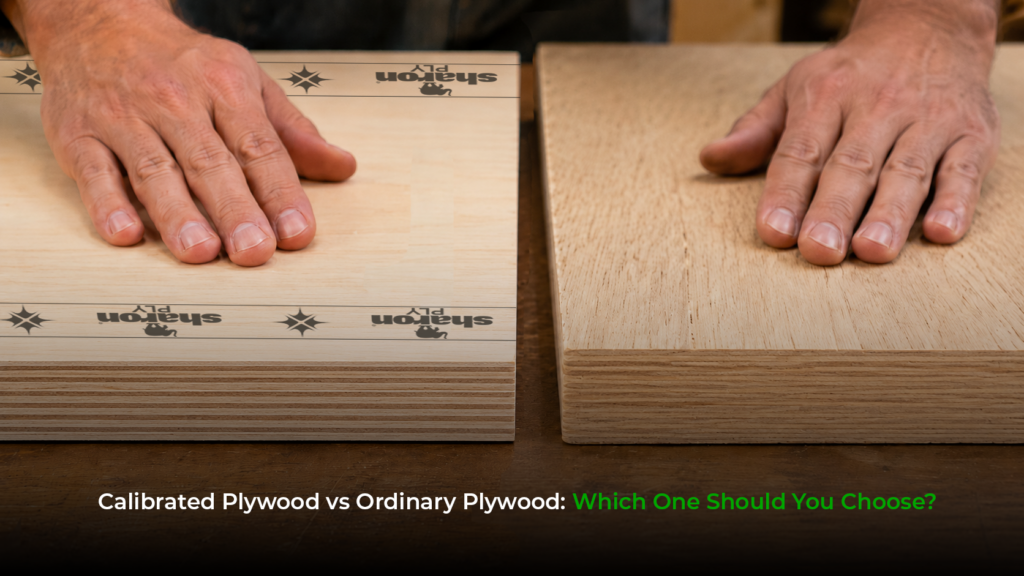
When selecting plywood for an interior project, most people focus on factors such as thickness, grade, moisture resistance and budget. These are all important considerations, but there is another specification that has become increasingly relevant as modular furniture gains popularity: calibration.
Homeowners often encounter the term “calibrated plywood” while planning modular kitchens, wardrobes or factory-made furniture. Naturally, this raises an important question. How is calibrated plywood different from regular plywood, and does it actually offer any advantages?
The answer depends largely on how the plywood will be used. Both calibrated and regular plywood can deliver excellent performance when manufactured to high standards. The key difference lies in the precision of the board rather than its basic construction.
Understanding where that precision matters can help homeowners, interior designers and contractors make a more informed decision.
Table of Contents
Calibrated plywood undergoes an additional manufacturing process that ensures uniform thickness across the entire sheet.
After the plywood is pressed, it passes through specialized calibration sanding machines that remove minor surface irregularities and achieve greater dimensional accuracy. As a result, the board maintains a more consistent thickness throughout.
For example, a calibrated 19 mm plywood sheet is designed to maintain nearly the same thickness across the entire panel, subject to standard manufacturing tolerances.
This level of consistency may seem like a small detail, but it can make a noticeable difference in projects where precision is important.
Ordinary plywood follows the standard manufacturing process of veneer assembly, bonding, pressing and finishing. When produced by a reliable manufacturer, it can offer excellent strength, durability and moisture resistance.
The primary difference is that regular plywood may have minor thickness variations across the sheet. These variations are often small and may not affect many traditional carpentry applications.
Experienced carpenters frequently work with such variations and can make adjustments during fabrication when required. For many conventional furniture projects, these minor differences are unlikely to create significant challenges.
The choice between calibrated and regular plywood therefore depends more on the requirements of the project than on the overall quality of the material.
A difference of one or two millimeters may not seem significant when looking at a plywood sheet. However, in modern furniture manufacturing, even small variations can influence the outcome.
Modular kitchens, wardrobes and factory-produced furniture rely on precision cutting, edge banding and machine-based assembly. When panel thickness varies, it can affect the alignment of components and the quality of the finished product.
Thickness consistency plays a role in:
The difference is often most noticeable in projects where multiple panels must fit together seamlessly. Uniform thickness helps create cleaner lines, tighter joints and a more refined appearance.
A calibrated board provides a more even base for laminates, veneers and decorative finishes.
When the underlying surface remains consistent, finishing materials sit more evenly and contribute to a smoother overall appearance. This becomes particularly important in contemporary interiors where clean, uninterrupted surfaces are often part of the design intent.
Furniture manufacturing today increasingly relies on CNC routers, panel saws and automated edge banding systems.
These machines perform best when material dimensions remain predictable. Consistent thickness allows machinery to operate more accurately, reducing the need for adjustments during production.
For manufacturers and modular furniture factories, this consistency supports both efficiency and finishing quality.
Furniture components fit together more precisely when the material maintains a uniform thickness.
Whether it is a wardrobe shutter, drawer system or modular kitchen cabinet, accurate joinery contributes to both structural stability and visual appeal. Better-fitting components often result in cleaner assembly and a more polished finished product.
Laminate application depends heavily on the quality and consistency of the substrate beneath it.
An uneven surface can sometimes affect pressure distribution during the lamination process, particularly in large-scale manufacturing environments. Calibrated plywood helps create a more predictable foundation, supporting consistent finishing outcomes across multiple panels.
This is one of the most common misconceptions surrounding calibrated plywood.
Calibration does not automatically make plywood stronger. The process is intended to improve dimensional accuracy rather than structural performance.
The strength of plywood depends on several other factors, including:
A well-manufactured regular plywood sheet can be stronger than a poorly constructed calibrated board. For this reason, calibration should never be viewed as a substitute for overall product quality.
When evaluating plywood, strength and calibration should be considered as separate characteristics.
Calibration and moisture resistance are often confused, but they serve entirely different purposes.
A plywood sheet can be calibrated and still be available in different grades such as MR, BWR or BWP, depending on the adhesive system used during manufacturing.
For kitchens, utility areas and locations exposed to higher moisture levels, selecting the correct grade remains essential. Calibration may improve dimensional consistency, but it does not determine how well the board resists moisture.
Before making a purchase, homeowners should always verify both the plywood grade and whether the board is calibrated. Each specification addresses a different performance requirement.
Not necessarily.
Many traditional carpentry projects continue to perform exceptionally well with high-quality regular plywood. Bookshelves, partitions, storage units and various furniture applications can often be completed successfully without the need for calibrated boards.
However, calibration becomes increasingly valuable when precision manufacturing is involved.
Projects that typically benefit from calibrated plywood include:
In these applications, dimensional consistency helps improve fabrication accuracy and finishing quality.
The decision should be based on project requirements rather than the assumption that calibrated plywood is always superior.
Because calibration involves additional processing, calibrated plywood generally carries a higher price than regular plywood.
Whether the additional cost is justified depends on the intended application.
For projects that rely heavily on machine-based manufacturing and precision assembly, the investment often delivers value through improved consistency and reduced fabrication adjustments.
For simpler furniture applications, regular plywood may provide all the performance required without the added expense.
The most practical approach is to balance project needs, budget and expected finishing standards before making a decision.
Even the best plywood can under perform if it is not handled properly before installation.
Exposure to moisture, uneven storage conditions and poor site handling practices can affect plywood performance regardless of whether it is calibrated or regular.
Boards should be stored on flat, elevated surfaces and protected from direct contact with water. Proper storage helps preserve dimensional stability and ensures the material performs as intended during fabrication and installation.
Good manufacturing practices and proper site handling work together to deliver the best results.
Material quality is only one part of a successful interior project.
Accurate cutting, proper hardware installation, edge sealing and finishing all contribute to the long-term performance of furniture. Even premium plywood requires skilled workmanship to achieve the desired result.
Experienced carpenters and fabricators understand how to work with different materials and apply appropriate techniques during assembly. Their expertise plays a major role in determining how well the finished product performs over time.
The best outcomes are achieved when quality materials and quality workmanship come together.
The choice between calibrated plywood and Ordinary plywood is not about identifying a universally better option. It is about selecting the material that best matches the needs of the project.
Calibrated plywood offers greater thickness consistency, improved machining accuracy and more predictable finishing results. These advantages make it particularly suitable for modular furniture and precision manufacturing environments.
Ordinary plywood remains a reliable and practical solution for many conventional interior applications when sourced from a trusted manufacturer and matched to the appropriate grade.
At SharonPly, years of experience across residential and commercial projects have shown that successful interiors begin with informed material selection. Understanding where calibration adds value helps homeowners and professionals invest wisely while achieving the performance and finish they expect.










Users understand that SHARONPLY is committed to protecting the User’s privacy and shall take all efforts to protect any personal data provided to the Website by reasonable security safeguards against such risks as loss or unauthorised use, destruction, modification or disclosure of data, However, in case of any lapse, SHARONPLY shall not be held responsible for any effect or consequences thereof. The Website uses cookies to track usage of the path of the User. Since most web browsers automatically accept cookies, User can edit User’s browser options to block them if User does not want the Website to use cookies to track usage of the path of the User.
SHARONPLY undertakes not to disclose, except as otherwise provided, the personal information provided by the User to any person, unless such action is necessary to: –
By filling up any form on the Website User automatically grants SHARONPLY a royalty-free, perpetual, irrevocable non-exclusive license to use, reproduce, publish, edit, distribute, and publicly display the information given in the form and to sublicense such rights.
Any queries regarding the SHARONPLY’s privacy policy, may be sent to admin@sharonply.com.