

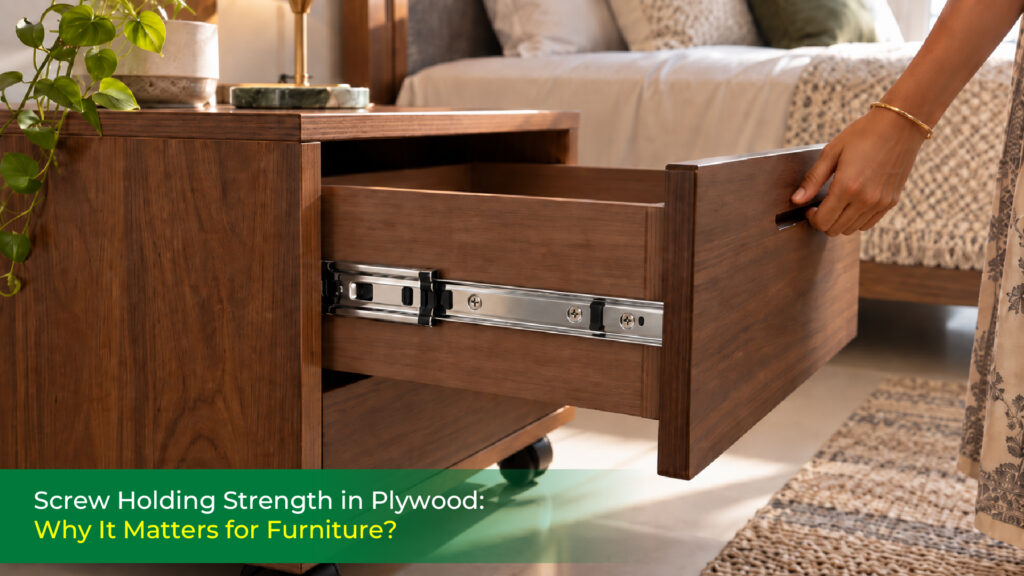
Strength is usually among the top considerations that people make when selecting their plywood for making furniture. Other considerations include thickness, grade, water-resistant nature, and surface qualities. One important consideration which is not discussed much is the screw holding strength of the plywood.
Screw appears to be an insignificant component, but it actually plays a critical role in keeping the furniture together. Hinges, handles, drawer tracks, brackets, and other parts need screws to be strongly held by the plywood.
This is the reason the screw holding strength of the plywood becomes important.
Screw holding strength refers to the ability of plywood to hold a screw securely without the screw becoming loose or pulling out under an applied force.
It is influenced by several factors, including veneer quality, core construction, bonding, plywood thickness and the way the screw is installed.
A plywood panel does not hold a screw simply because it is thick. The internal structure of the panel matters too. Well-constructed plywood provides a more consistent material around the screw, allowing it to grip the wood fibers effectively.
Testing methods for screw withdrawal are used in the wood and panel industry to evaluate this property. However, test values should always be considered in relation to the plywood type, thickness and intended application.
Furniture goes through repeated opening, closing, loading and movement. A wardrobe shutter may be opened several times a day. Kitchen drawers experience repeated pulling. Cabinet hinges transfer load to the screws every time a door is operated.
Over time, these repeated forces can expose weaknesses in the material or installation.
If screw holding is inadequate, hardware may gradually become loose. Hinges can shift, handles may wobble and drawer fittings may stop sitting correctly. Repairing the hardware repeatedly can become inconvenient and may eventually damage the surrounding plywood.
This is where material choice matters. A plywood panel with good screw holding characteristics provides a stronger base for fixing hardware correctly.
Plywood is made by bonding layers of wood veneers together, generally with the grain direction alternating between adjacent layers. The quality and consistency of these layers influence the behaviour of the finished panel.
A well-constructed core provides a more uniform structure for screw penetration. Voids, poorly bonded areas or inconsistent core construction can reduce the amount of solid material available around a screw.
This becomes particularly relevant near edges, corners and areas where hardware is installed.
The bonding system also matters. Strong and consistent bonding helps maintain the integrity of the plywood layers when the panel is drilled or fastened.
Thickness can influence screw holding, but it should not be viewed as the only deciding factor.
A thicker panel generally provides more material for a screw to engage with. However, a poorly constructed thick panel may not necessarily perform better than a well-made panel of a suitable thickness.
The screw length and diameter should also be appropriate for the plywood thickness and the hardware being installed. Excessively long screws can cause problems, while screws that are too short may not provide sufficient engagement.
In practical use, plywood thickness, core construction and fixing method should be considered together.
The core is particularly important because screws often pass through the face veneer and into the internal layers.
A consistent, well-bonded core can provide better support around the screw. On the other hand, internal gaps or weak areas can result in inconsistent screw engagement.
This is one reason why judging plywood only by its surface appearance can be misleading. A smooth face does not reveal everything about the construction inside the panel.
For furniture manufacturers and carpenters, consistency within the core can make a noticeable difference during fabrication and installation.
Moisture is another factor that should not be overlooked in Indian homes.
Plywood is a wood-based material, so changes in moisture conditions can influence its dimensions and mechanical behaviour. Prolonged moisture exposure may affect the wood, adhesive bonds, finishes and the surrounding furniture components.
This is especially important in kitchens, utility areas and other moisture-prone locations.
Choosing suitable waterproof ply woods or other moisture-resistant grades for the application can help reduce moisture-related problems. However, no plywood should be treated as completely unaffected by prolonged water exposure.
Good ventilation, proper edge protection and timely attention to leaks are equally important.
Yes. Even good-quality plywood can perform poorly if screws are installed incorrectly.
Using the right screw type, diameter and length is important. Over-tightening can damage the material around the fixing point. Incorrect drilling, excessive force or repeated removal and refitting of screws can also weaken the surrounding area.
Carpenter skill therefore becomes part of the overall performance equation.
Hardware should be positioned correctly, and fixings should be selected according to the load and application. Heavy shutters, shelves and frequently used fittings may require more careful fixing than lightweight furniture components.
Screw holding strength should be considered along with other plywood characteristics rather than treated as an isolated specification.
Look at the plywood grade, thickness, core construction, bonding quality, intended application and relevant test data. For furniture that carries significant hardware loads, asking about screw holding performance can provide useful information beyond the usual questions about surface finish and moisture resistance.
Storage and handling also matter. Sheets should be stored flat, protected from excessive moisture and handled carefully before fabrication. Damage to edges or corners can affect later cutting and fixing.
Screw holding strength is an aspect of furniture durability which may be minor but significant. Screw holding strength determines the stability of hinges, handles, drawer systems and other furniture hardware.
Well-constructed plywood, appropriate plywood thickness, quality core and adequate bonding form the basis. Proper screw choice and installation finishes the job. Moisture protection and proper care will improve plywood performance as well.
Decades of experience have taught SharonPly that plywood should suit how furniture is made and used. Consider screw-holding strength alongside grade, construction and application to make the right choice.









Users understand that SHARONPLY is committed to protecting the User’s privacy and shall take all efforts to protect any personal data provided to the Website by reasonable security safeguards against such risks as loss or unauthorised use, destruction, modification or disclosure of data, However, in case of any lapse, SHARONPLY shall not be held responsible for any effect or consequences thereof. The Website uses cookies to track usage of the path of the User. Since most web browsers automatically accept cookies, User can edit User’s browser options to block them if User does not want the Website to use cookies to track usage of the path of the User.
SHARONPLY undertakes not to disclose, except as otherwise provided, the personal information provided by the User to any person, unless such action is necessary to: –
By filling up any form on the Website User automatically grants SHARONPLY a royalty-free, perpetual, irrevocable non-exclusive license to use, reproduce, publish, edit, distribute, and publicly display the information given in the form and to sublicense such rights.
Any queries regarding the SHARONPLY’s privacy policy, may be sent to admin@sharonply.com.