
The materials used in making furniture affect the performance of the furniture in a significant way. Although the surface might look the same, the material inside affects its sturdiness, screwing, water resistant nature, and longevity.
Plywood and particle board are among the most common panel materials used in making furniture. Both materials have different ways of manufacturing and also different properties under loading and moisture.
So, which of them is stronger and more appropriate for making furniture?
The answer to this question will depend on the purpose, but when it comes to strength and longevity, plywood will be more versatile.
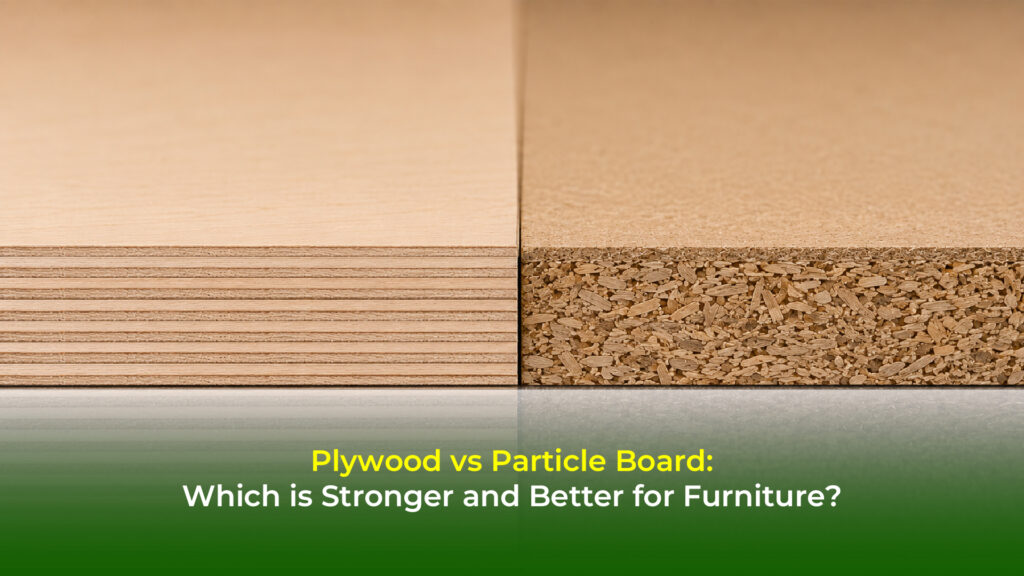
Plywood is made by bonding thin layers of wood veneer together. The grain direction of adjacent veneers is typically arranged at right angles. These cross-laminated layers create a stable panel with good strength in multiple directions.
Particle board is manufactured differently. Wood particles or chips are combined with resin and compressed under heat and pressure to form a solid panel.
The difference in construction affects how the two materials respond to loads, fasteners and moisture.
Plywood has a layered structure. Particle board has a more uniform composition of compressed wood particles.
Neither is automatically suitable for every application. The intended use should determine the material.
For most structural furniture applications, plywood has an advantage in strength-to-weight performance.
Its cross-laminated veneer structure allows it to handle bending and repeated loads effectively. The actual strength still depends on factors such as veneer quality, thickness, core construction, bonding quality and manufacturing standards.
Particle board can provide adequate strength for many lightweight furniture applications. However, its mechanical performance is generally more limited, particularly when the board is subjected to high loads or repeated stress.
For shelves, kitchen carcasses, wardrobes and furniture that needs to hold weight over long periods, plywood is often the more dependable option.
This is where material choice matters.
Furniture relies heavily on screws, hinges, drawer channels and other hardware.
Plywood generally offers good screw-holding performance because its veneer structure provides multiple layers for fasteners to engage with.
Particle board can hold screws adequately when properly specified and installed. However, repeated removal and refitting of screws can weaken the surrounding material, particularly near edges.
This becomes important in frequently used furniture.
Kitchen shutters, wardrobe doors and office storage systems are opened and closed repeatedly. Hardware is also subjected to continuous movement.
In practical use, the ability of the base material to retain fasteners contributes significantly to furniture longevity.
Moisture is another important difference.
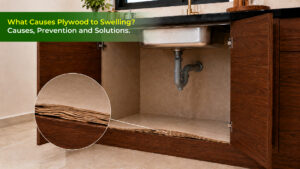
A standard particle board is relatively sensitive to water. If exposed to moisture, the particles can absorb water and expand. Once swelling occurs, the board may lose its original shape and structural integrity.
Plywood performance depends on its grade.
MR-grade plywood is intended primarily for dry interior applications. Waterproof ply woods, such as BWP-grade products manufactured to relevant standards including IS 710, are designed for applications involving greater moisture exposure.
This makes plywood more adaptable to Indian interior conditions, particularly in kitchens, utility areas and homes located in humid or monsoon-prone regions.
However, even waterproof plywood should not be treated as completely immune to water damage. Proper edge sealing, installation and maintenance remain important.
Kitchens are among the most demanding furniture environments in a home.
Steam, water splashes, cleaning activities and plumbing leaks can expose cabinet materials to moisture.
Particle board may be suitable for selected dry components or budget-focused applications where moisture exposure is well controlled. However, it is generally less forgiving when water enters the material.
For sink units, lower cabinets and areas close to plumbing, waterproof plywood is usually the more suitable choice.
Upper cabinets that remain away from direct moisture may have different requirements.
Good specification considers exposure rather than applying the same material throughout the kitchen.
Wardrobes generally experience lower moisture exposure than kitchens.
Particle board can work effectively in wardrobes when the environment is dry and the furniture is properly constructed.
Plywood offers greater flexibility where heavier shelves, frequent hardware use or longer service life are priorities.
For wardrobes installed against damp walls or in humid homes, moisture resistance becomes more relevant.
Adequate ventilation and a small clearance from potentially damp walls can also help reduce moisture-related problems.
Particle board is often relatively dense and can be heavy for its strength.
Plywood can provide a useful balance between strength and weight, depending on its construction and thickness.
This can make a difference during transportation, installation and fabrication.
For large wardrobes, modular kitchens and office furniture, material weight affects how components are handled and supported.
However, thickness should not be selected based on weight alone. Span, load and furniture design must also be considered.
Both plywood and particle board can be finished with laminates, veneers, paints or other decorative surfaces.
Particle board provides a relatively uniform surface that can work well for certain factory-made furniture applications.
Plywood offers greater flexibility for fabrication and can perform well in applications involving machining, screw fixing and structural joinery.
The final appearance also depends on the quality of the substrate, adhesive application, finishing materials and workmanship.
A good surface finish cannot compensate for an unsuitable core material.
Particle board generally has a lower initial cost, which makes it attractive for budget-sensitive furniture.
Plywood usually costs more because of its veneer construction, manufacturing process and performance characteristics.
The right comparison, however, is not always purchase price versus purchase price.
Furniture replacement, hardware repairs, swelling, edge damage and moisture-related failures can increase the overall cost of a lower-priced material.
For low-load, dry applications, particle board may provide reasonable value.
For furniture expected to withstand heavier use, moisture exposure or repeated hardware movement, the additional investment in plywood may be justified.
Choosing plywood everywhere is not necessarily the most economical approach.
Particle board can have a practical role in dry, low-load furniture applications where moisture exposure is minimal and cost is an important consideration.
Plywood becomes more valuable where strength, screw retention, durability and moisture resistance are higher priorities.
The best specification is therefore application-specific.
Whether it be the choice of any particular material, site handling is a determinant of performance.
Planks should be stored flat and out of reach of rain and damp floor surfaces. Precision cutting and edge finishing is a must based on the application.
Lack of proper craftsmanship reduces the performance of the most superior material.
In time, proper installation becomes as vital as the initial choice of board.
Plywood and particle board are examples of engineered woods suited for specific functional requirements. It is possible to utilize particle board in some instances of light-duty dry furniture at an economical cost.
Plywood offers more flexibility in terms of strength, screw retention, moisture resistance, and durability. The suitable type and thickness of plywood must be considered for the intended purpose.
SharonPly, after many years of experience in Indian interiors, has come up with one clear rule regarding the production of good furniture. This starts with selecting a suitable material for the intended purpose of the furniture.




Users understand that SHARONPLY is committed to protecting the User’s privacy and shall take all efforts to protect any personal data provided to the Website by reasonable security safeguards against such risks as loss or unauthorised use, destruction, modification or disclosure of data, However, in case of any lapse, SHARONPLY shall not be held responsible for any effect or consequences thereof. The Website uses cookies to track usage of the path of the User. Since most web browsers automatically accept cookies, User can edit User’s browser options to block them if User does not want the Website to use cookies to track usage of the path of the User.
SHARONPLY undertakes not to disclose, except as otherwise provided, the personal information provided by the User to any person, unless such action is necessary to: –
By filling up any form on the Website User automatically grants SHARONPLY a royalty-free, perpetual, irrevocable non-exclusive license to use, reproduce, publish, edit, distribute, and publicly display the information given in the form and to sublicense such rights.
Any queries regarding the SHARONPLY’s privacy policy, may be sent to admin@sharonply.com.