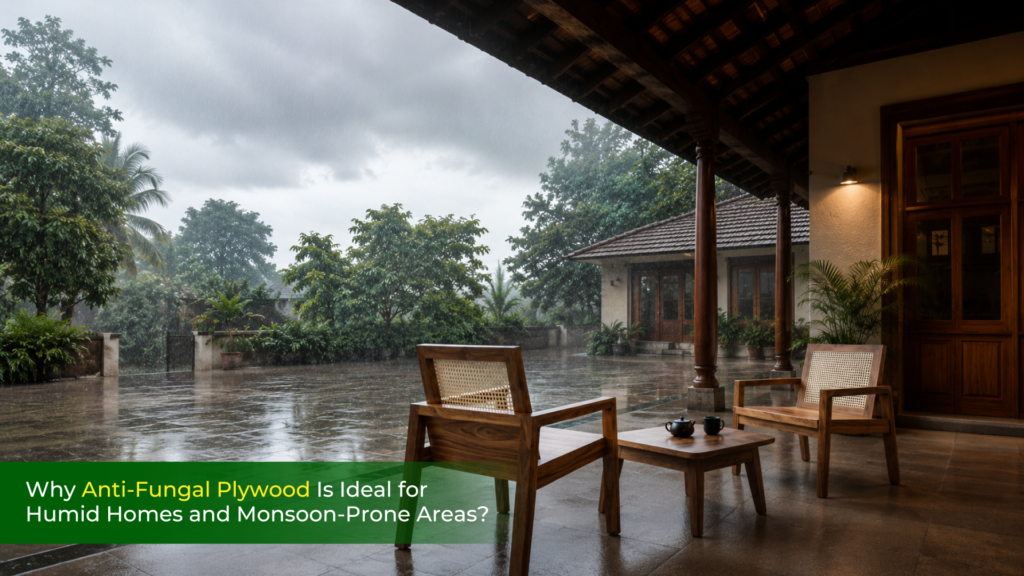
Humidity is one of the biggest challenges for wood-based interiors in India.
From humid cities like Chennai and Kochi to regions with prolonged monsoon seasons, excess moisture can slowly damage furniture, cabinets, and wall panels. Even though obvious water damage attracts attention, fungal growth usually takes place gradually until it starts to affect the appearance and strength of the plywood.
This is where material choice matters.
Anti-fungal plywood is designed to provide added protection against fungal growth, making it a practical option for homes located in humid environments. When combined with the right plywood grade and proper installation, it helps improve the long-term performance of interiors.
Humidity causes trouble for plywood for many reasons. There are several reasons why humidity poses problems for plywood.
Wood is a natural substance which reacts to the conditions around it.
There is a greater moisture content inside wood panels under high humidity. The presence of moisture for a long time allows the formation of fungi, especially in poorly ventilated places.
Common locations include:
In actual practice, these areas may not be exposed directly to water on a daily basis. But moisture can still take a toll on the material over time.
For long-term durability, proper moisture management is critical.
Anti-fungal plywood is manufactured using preservative treatments that help resist fungal growth under suitable environmental conditions.
The treatment is generally applied during manufacturing so that the protection extends beyond the surface of the board.
The plywood itself continues to rely on the same engineering principles as conventional plywood. Cross-laminated veneers are bonded under heat and pressure to provide structural strength and dimensional stability.
The additional anti-fungal treatment helps improve resistance where humidity remains consistently high.
It is important to realize that anti-fungal treatment will decrease the risk of fungal growth. It does not replace the need for adequate ventilation and maintenance.
It can be difficult to distinguish between anti-fungal protection and water resistance.
Waterproof plywoods are manufactured using adhesive systems like phenol formaldehyde resin which make the bond between veneers resist long exposure to water. Kitchens, wet areas, utility areas are typical places where a product made to a standard like IS 710 is chosen.
Anti-fungal plywood emphasizes against fungal growth.
A few high quality products of plywood are even combined with anti-fungal property as well as moisture resistance. One characteristic should not be assumed because of the other characteristic, however. Please check the product specification before choosing the plywood for a project.
Certain interior applications benefit more than others.
Homes located in coastal regions or areas with extended monsoon seasons often experience consistently high indoor humidity.
In such situations, anti-fungal plywood may be particularly suitable for:
Furniture positioned near exterior walls or areas with limited airflow may also benefit from additional fungal resistance.
The right application depends on environmental conditions as much as the material itself.
Anti-fungal treatment is only one aspect of plywood quality.
Long-term performance also depends on:
Poorly manufactured plywood with anti-fungal treatment cannot compensate for weak bonding or inferior core construction.
Over time, this becomes noticeable through loose hardware, uneven surfaces or dimensional instability.
Balanced product evaluation always delivers better results than focusing on a single feature.
Even high-quality plywood can absorb unnecessary moisture if stored improperly before installation.
Boards should be stacked on flat, raised surfaces and protected from direct rain or damp flooring.
Job sites often expose materials to changing weather. During the monsoon, improper storage may increase moisture absorption before the furniture is even fabricated.
In practical use, correct site handling supports the performance designed into the product.
ensure its performance as designed.
Good manufacturing and good storage go hand-in-hand.
The long-term results of the installation are influenced by the installation.
Workmanship will also affect the performance of anti-fungal plywood.
Cut edges should be sealed properly. Water should not be allowed to seep through sink areas. Where possible, enclose storage and ensure there is sufficient ventilation within wardrobes.
The level of carpentry skills is different among projects. When installing, attention is paid to reducing points of moisture entry that can impact long term durability.
Maintenance techniques are also pivotal after installation.
Dry cabinets, quick fix on plumbing leakage and proper ventilation have a positive impact on the health of the interior.
Anti-fungal plywood may carry a higher price compared to conventional alternatives because of the additional treatment involved.
The value depends largely on the project location and exposure conditions.
For homes in dry climates with excellent ventilation, standard plywood grades may be sufficient for many interior applications.
However, in coastal cities and monsoon-prone regions, additional resistance against fungal growth can reduce maintenance concerns and help preserve furniture for longer periods.
Material selection should always balance climate, budget and expected service life.
Choosing the right plywood for the right application often provides better value than selecting the highest specification everywhere.
Not all the time is humidity controllable; in tropical areas, for example.
But, it can be minimized by smart material choices in interiors.
For humid environments, use anti-fungal plywood with the proper waterproof plywood grades for moisture exposure to offer a more balanced approach.
Caution in installation, routine maintenance and good ventilation are still important.
No single product can replace sound construction practices.
Homes in humid regions place greater demands on plywood than homes in dry climates.
Continuous exposure to moisture and limited airflow create favorable conditions for fungal growth, making material selection an important part of long-term interior performance.
Anti-fungal plywood offers an additional layer of protection by helping resist fungal growth while maintaining the strength and versatility expected from quality plywood.
When paired with the appropriate waterproof plywood grade, careful installation and responsible maintenance, it supports more durable and dependable interiors.
With decades of experience in different climatic conditions across the globe in India, SharonPly has discovered that making informed decisions to start with is the first step to a successful interior. One of the best ways to enhance long term performance and minimize future maintenance issues is to choose plywood that is a match for the environment.




Users understand that SHARONPLY is committed to protecting the User’s privacy and shall take all efforts to protect any personal data provided to the Website by reasonable security safeguards against such risks as loss or unauthorised use, destruction, modification or disclosure of data, However, in case of any lapse, SHARONPLY shall not be held responsible for any effect or consequences thereof. The Website uses cookies to track usage of the path of the User. Since most web browsers automatically accept cookies, User can edit User’s browser options to block them if User does not want the Website to use cookies to track usage of the path of the User.
SHARONPLY undertakes not to disclose, except as otherwise provided, the personal information provided by the User to any person, unless such action is necessary to: –
By filling up any form on the Website User automatically grants SHARONPLY a royalty-free, perpetual, irrevocable non-exclusive license to use, reproduce, publish, edit, distribute, and publicly display the information given in the form and to sublicense such rights.
Any queries regarding the SHARONPLY’s privacy policy, may be sent to admin@sharonply.com.