
Every interior project begins with a vision, but its long-term success depends on the materials used behind the finished surfaces.
Whether it is a modular kitchen, a bedroom wardrobe, office furniture or decorative wall paneling, plywood forms the structural foundation of many interior applications. Choosing the right plywood is not simply about selecting the thickest board or the highest grade. Different spaces place different demands on the material.
This is where material choice matters.
Moisture levels, daily usage, load requirements, ventilation and installation quality all influence how plywood performs over time. Understanding these factors helps homeowners and professionals select the right product for the right purpose.
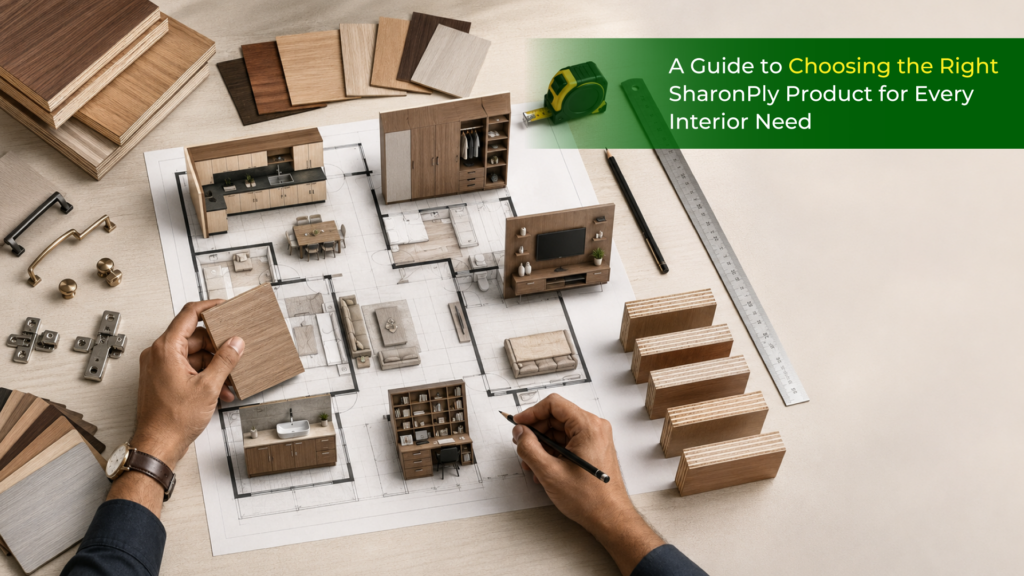
The first step is to evaluate where the plywood will be used.
Questions worth considering include:
Answering these questions makes product selection more practical than simply comparing prices.
No single plywood grade is ideal for every application.
The kitchen is constantly exposed to steam, splashes of water, and high humidity levels.
Lower cabinets, sinks and utility zones are especially prone to damage due to plumbing leaks and the accumulation of moisture, which can take place gradually.
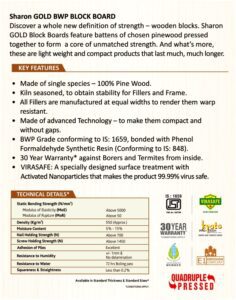
In such conditions, waterproof plywoods that are made with a BWP bond system are commonly suggested.
For instance, phenol formaldehyde resin is used to keep adhesion strong even when subjected to moisture continuously.
Nevertheless, being waterproof does not relieve from the necessity of correct installation.
Edges should be well-sealed, plumbing must be checked, and cabinets should be kept dry from any water sources.
Bedrooms, wardrobes and TV units usually experience relatively dry indoor conditions.
For these applications, MR-grade plywood may often provide suitable performance, provided the environment remains free from excessive moisture.
Homes located in coastal regions or areas with consistently high humidity may require more careful evaluation.
Climate should always influence material selection.
Over time, this becomes noticeable.
Furniture installed in humid environments experiences greater dimensional stress than similar furniture in dry regions.
Selecting the appropriate plywood grade helps improve long-term stability.
Modern modular furniture depends heavily on dimensional accuracy.
Wardrobes, kitchens and office furniture manufactured using CNC machines require plywood with consistent thickness across every sheet.
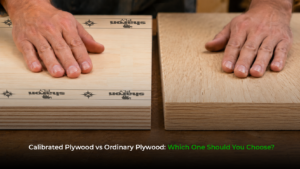
Calibrated plywood undergoes additional sanding processes that improve thickness uniformity.
This results in:
Calibration does not increase structural strength. Instead, it improves manufacturing precision.
Projects involving modular furniture often benefit most from this additional consistency.
Air quality inside buildings has become a crucial factor in the design of houses.
Children’s rooms, bedrooms and living spaces can especially enjoy low-emission materials.
Low-emission plywood is produced using technologies which are aimed at lowering the release of formaldehyde without losing their technical qualities.
Materials which correspond to certain standards, for example, E1 or E0 emission classes, are useful in ensuring healthy air inside.
It should be noted that indoor air quality is affected by various materials.
Paints, laminates, adhesives, and ventilation are among them.
A balanced combination of materials is the key to success.
Humidity affects more than structural stability.
It can also encourage fungal growth where ventilation remains limited.
Homes located in coastal regions or monsoon-prone areas often experience prolonged periods of elevated humidity.
In such situations, anti-fungal plywood provides an additional level of protection.
Wardrobes, storage cabinets and wall paneling installed against exterior walls may particularly benefit.
The treatment helps reduce the likelihood of fungal growth but should always be supported by good ventilation and responsible maintenance.
Certain applications place greater emphasis on fire safety.
Electrical panel enclosures, commercial interiors, kitchens and public buildings often require materials with improved fire performance.
Fire retardant plywood is treated to reduce flame spread and delay ignition.
It does not make interiors fireproof.
Instead, it slows the progression of fire, providing valuable response time during emergencies.
Product selection should always be based on the specific safety requirements of the project.
Regardless of grade or treatment, plywood performance ultimately depends on manufacturing quality.
Strong core construction contributes to:
Surface appearance alone does not reveal internal quality.
This is where professional guidance often proves valuable.
Selecting plywood based solely on visible finish may overlook the factors that determine long-term durability.
Premium plywood will also fail to deliver if not handled properly.
Boards should be kept off the ground in dry conditions before installation.
Carpentry skills are also critical for long-lasting effects.
Edge protection, proper installation of fasteners and good finishing processes all ensure longevity of furniture pieces.
In reality, quality production and workmanship go hand-in-hand. Both need attention.
Choosing plywood does not require selecting the highest specification available.
It requires selecting the most appropriate specification.
For example:
Every interior project has different priorities.
Understanding those priorities leads to better material decisions, more durable furniture and fewer maintenance concerns in the future.
The choice of the appropriate plywood will be most efficient based on the purpose of its use rather than any assumptions.
There are various types of SharonPly that are suitable for various interior issues, thus, homeowners and specialists can select the materials which will suit their needs without resorting to a one-size-fits-all approach.
SharonPly has decades of production experience, and it knows that any durable interior starts with a correct choice of materials. The appropriate selection of plywood for each case will ensure that the furniture or other interior space will function well for many years to come.






Users understand that SHARONPLY is committed to protecting the User’s privacy and shall take all efforts to protect any personal data provided to the Website by reasonable security safeguards against such risks as loss or unauthorised use, destruction, modification or disclosure of data, However, in case of any lapse, SHARONPLY shall not be held responsible for any effect or consequences thereof. The Website uses cookies to track usage of the path of the User. Since most web browsers automatically accept cookies, User can edit User’s browser options to block them if User does not want the Website to use cookies to track usage of the path of the User.
SHARONPLY undertakes not to disclose, except as otherwise provided, the personal information provided by the User to any person, unless such action is necessary to: –
By filling up any form on the Website User automatically grants SHARONPLY a royalty-free, perpetual, irrevocable non-exclusive license to use, reproduce, publish, edit, distribute, and publicly display the information given in the form and to sublicense such rights.
Any queries regarding the SHARONPLY’s privacy policy, may be sent to admin@sharonply.com.