
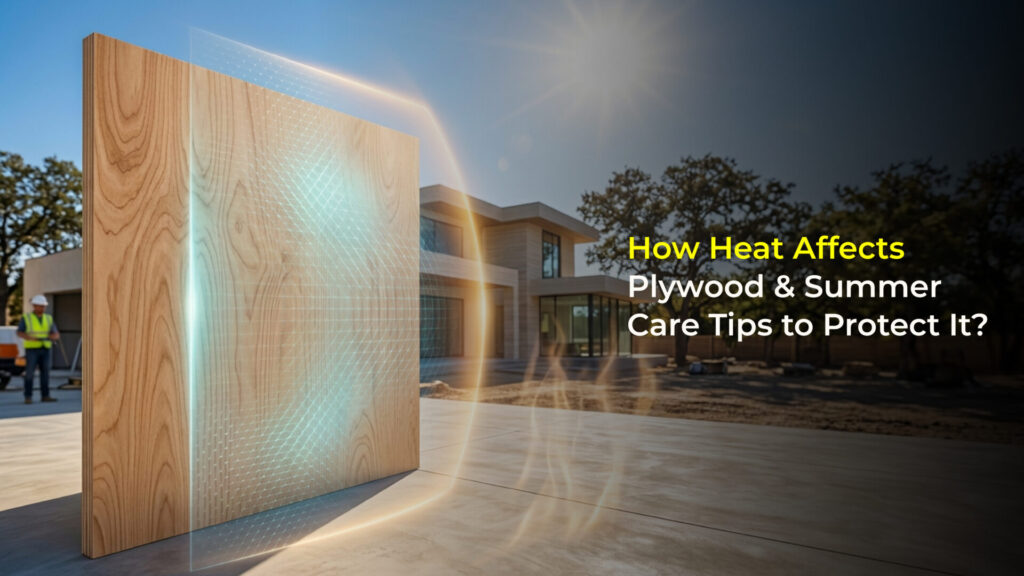
Summer conditions can be demanding on interiors, especially in many parts of India where temperatures rise sharply and humidity levels fluctuate. While plywood is designed to handle regular environmental changes, prolonged heat exposure can still affect its performance over time.
In practical use, damage caused by summer conditions is usually gradual. Panels may begin to warp slightly. Surface finishes can lose stability. Adhesive bonds may weaken if the material is poorly manufactured or incorrectly installed.
Understanding how heat interacts with plywood helps homeowners and professionals make better decisions during both material selection and maintenance.
Plywood is an engineered wood product made by bonding multiple veneers under heat and pressure. This cross-layered construction improves dimensional stability compared to solid wood.
However, plywood still responds to environmental conditions. Heat affects both the wood fibres and the adhesive layers inside the panel.
When exposed to excessive temperatures for long periods, plywood can lose moisture rapidly. This uneven moisture movement may create internal stress within the board.
Over time, this becomes noticeable in the form of slight bending, surface cracks or edge separation, especially in lower-grade materials.
Many people assume that summer damage comes only from dry heat. In reality, the combination of heat and humidity creates greater stress on interiors.
In coastal and tropical regions, plywood often experiences cycles of moisture absorption and drying within short periods. This repeated movement affects dimensional stability.
This is where material choice matters. Higher-grade plywood with stable bonding systems handles these fluctuations more effectively than lower-grade alternatives.
Waterproof plywoods such as BWP grade are commonly preferred in areas exposed to both heat and moisture because their bonding strength remains more stable under changing conditions.
Certain parts of the home experience more heat exposure than others.
Kitchen cabinets near cooking zones face both temperature and steam. Window-side furniture receives direct sunlight for long hours. Loft storage units near ceilings often trap heat due to poor ventilation.
In practical use, these are the areas where material stress appears first.
Plywood used in such locations benefits from proper thickness selection, quality core construction and protective finishing.
The internal structure of plywood plays a major role in how it handles heat.
High-quality plywood uses evenly arranged veneers with controlled moisture content during manufacturing. Strong bonding and compact core construction reduce internal movement.
Lower-quality boards often contain gaps or inconsistent veneer layers. Under heat, these weak sections expand and contract unevenly, leading to distortion or surface irregularities.
Over time, this affects both appearance and structural stability.
One of the simplest ways to protect plywood interiors is by reducing prolonged direct heat exposure.
Furniture and cabinets placed near windows benefit from curtains, blinds or UV-protective films. This helps reduce surface heating during peak afternoon temperatures.
In kitchens, maintaining proper ventilation lowers heat buildup around cabinets and storage sections.
These small adjustments help slow down moisture loss and reduce stress within the material.
Ventilation plays a larger role than many homeowners realise.
Poor airflow traps heat and humidity inside enclosed spaces. Wardrobes, lofts and utility cabinets are especially affected.
Allowing regular air circulation helps maintain more stable environmental conditions around plywood interiors.
In practical use, well-ventilated spaces tend to show fewer issues related to warping or surface deterioration during summer months.
Edges are more vulnerable to environmental stress than flat surfaces.
When exposed to heat and humidity, unsealed edges absorb and release moisture faster. This creates uneven expansion within the panel.
Using laminates, veneers and proper edge banding helps protect the plywood from direct exposure.
This is especially important for kitchen cabinets, window-side furniture and bathroom storage units.
Heat alone does not usually cause major plywood damage. Problems increase when heat combines with hidden moisture.
Small plumbing leaks, condensation or damp walls can create internal stress when temperatures rise. The plywood repeatedly absorbs and releases moisture, weakening the structure over time.
In practical use, these issues often remain unnoticed until swelling or surface damage becomes visible.
Regular inspection during summer helps identify such problems early.
During renovation or construction work, plywood is sometimes stored carelessly on site.
Sheets exposed to direct sunlight or stacked against damp walls can absorb uneven moisture before installation. This affects dimensional stability later.
Plywood should always be stored flat, elevated from the floor and protected from excessive heat and humidity.
Proper handling before installation contributes significantly to long-term performance.
A common belief is that thicker plywood automatically performs better in hot conditions. While thickness adds stability, core quality and bonding consistency are equally important.
Another misconception is that waterproof plywoods are unaffected by heat. In reality, even high-grade plywood responds to environmental changes, though it handles them more effectively.
There is also an assumption that summer damage appears immediately. Most issues develop gradually and become visible only after repeated exposure.
Understanding these realities helps in making more balanced decisions.
Plywood performs best when material quality, installation and maintenance work together. Heat by itself is rarely the only factor behind damage. Environmental fluctuations, ventilation and moisture management all influence long-term durability.
Choosing the right grade for the application, protecting surfaces properly and maintaining good airflow can significantly improve how interiors perform through summer conditions.
With years of experience across different Indian climates, SharonPly has seen that interiors last longer when seasonal conditions are considered during both selection and installation. When plywood is used thoughtfully and maintained well, it continues to support interiors that remain stable, functional and dependable over time.






Users understand that SHARONPLY is committed to protecting the User’s privacy and shall take all efforts to protect any personal data provided to the Website by reasonable security safeguards against such risks as loss or unauthorised use, destruction, modification or disclosure of data, However, in case of any lapse, SHARONPLY shall not be held responsible for any effect or consequences thereof. The Website uses cookies to track usage of the path of the User. Since most web browsers automatically accept cookies, User can edit User’s browser options to block them if User does not want the Website to use cookies to track usage of the path of the User.
SHARONPLY undertakes not to disclose, except as otherwise provided, the personal information provided by the User to any person, unless such action is necessary to: –
By filling up any form on the Website User automatically grants SHARONPLY a royalty-free, perpetual, irrevocable non-exclusive license to use, reproduce, publish, edit, distribute, and publicly display the information given in the form and to sublicense such rights.
Any queries regarding the SHARONPLY’s privacy policy, may be sent to admin@sharonply.com.