

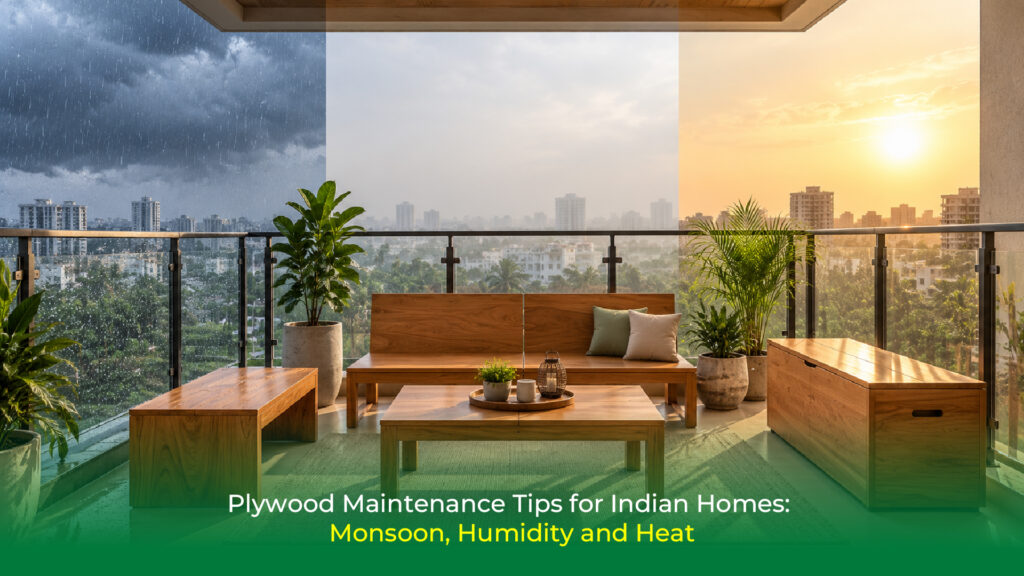
Plywood finds a variety of applications inside Indian homes in kitchens, wardrobes, storage furniture, bed rooms and partitioning. Even though plywood stays hidden once it is fitted, it does not become immune to its environment.
Conditions experienced inside Indian houses vary throughout the year. Monsoons are accompanied by long-lasting humidity and even some waterlogging. Summer season sees high heat and dry conditions. Humidity inside coastal houses will be for longer periods, whereas poorly ventilated houses will trap humidity inside them.
Well-fitted and good quality plywood will serve its purpose well for many years. But maintenance is essential. Good practices will keep one’s plywood protected from any moisture damage and wear & tear.
Wood is a naturally hygroscopic material. It absorbs and releases moisture depending on the surrounding environment. Plywood is engineered to provide better dimensional stability than solid wood, but it is not completely unaffected by changes in humidity.
During monsoons, prolonged humidity can increase the moisture content of wood-based panels. In summer, rapid changes in temperature and indoor humidity can create repeated expansion and contraction.
This does not mean plywood will automatically swell or warp. The extent of movement depends on the plywood grade, construction quality, moisture exposure, installation and environmental conditions.
The most important maintenance practice is to prevent prolonged contact with water.
Kitchen cabinets near sinks, bathroom storage and utility-area furniture are particularly vulnerable. Small plumbing leaks can remain unnoticed and allow water to collect around cabinet bases.
Clean up spills promptly and inspect areas around sinks, water purifiers and plumbing connections regularly.
For moisture-prone applications, the initial selection of suitable waterproof plywood or BWP-grade plywood is also important. Maintenance cannot compensate for using an unsuitable grade in a consistently wet environment.
The kitchen deserves particular attention during humid months.
Inspect the area below the sink for signs of dampness, swelling or changes in the laminate surface. Check plumbing joints and hoses for small leaks.
Also look at cabinet edges and joints. If moisture repeatedly reaches an exposed edge, the risk of swelling or deterioration increases.
A waterproof grade provides greater resistance, but keeping the cabinet dry remains the better approach.
Humidity can accumulate inside enclosed furniture.
Wardrobes placed against damp walls, cabinets in poorly ventilated rooms and storage units kept tightly closed for long periods can experience limited airflow.
During suitable weather, opening wardrobe doors and allowing air circulation can help reduce trapped moisture.
Avoid placing furniture directly against visibly damp walls. If there is persistent dampness, the underlying wall or plumbing issue should be addressed rather than relying on the furniture material alone.
The face of plywood is often protected by laminate, veneer, paint or another finishing material. Cut edges are more vulnerable because the internal veneer layers are exposed.
Proper edge banding or sealing helps reduce moisture entry.
This is particularly important around kitchen sinks, plumbing openings, counter tops and other areas where water may be present.
If an edge becomes damaged during regular use, repairing the finish early is preferable to allowing moisture to enter repeatedly.
Plywood furniture does not require excessive water for cleaning.
Use a soft, slightly damp cloth for routine cleaning and dry the surface afterwards. Avoid leaving wet clothes, cleaning liquids or standing water on cabinet surfaces.
Strong chemicals should also be used carefully. The suitability of a cleaning product depends on the surface finish, laminate or coating applied over the plywood.
In practical use, protecting the complete furniture system is more effective than focusing only on the plywood underneath.
A quick inspection after prolonged rainfall can identify small problems before they become expensive repairs.
Look for:
These signs do not always mean the plywood itself has failed. Moisture may have entered through plumbing, an unsealed edge, a damaged finish or a nearby wall.
Finding the source is important before replacing the affected component.
Plywood furniture experiences repeated mechanical stress.
Kitchen shutters, wardrobe doors and storage units are opened and closed frequently. Humidity can also affect hardware over time.
Check hinges, handles and screws periodically. Loose hardware should be tightened without excessive force.
If screws repeatedly become loose, the issue may be related to core construction, screw selection, repeated loading or incorrect installation. Simply tightening the same screw again may not address the underlying problem.
High temperatures can affect interior materials, particularly when combined with direct sunlight.
Avoid prolonged exposure of plywood furniture to strong direct sunlight wherever possible. This is especially relevant for surfaces finished with laminates, veneers or coatings, where colour and finish may change over time.
Good ventilation helps maintain more stable indoor conditions.
Summer maintenance is not about keeping plywood cool. It is about avoiding unnecessary temperature extremes and protecting the complete furniture system.
If plywood sheets remain after construction or renovation, storage conditions matter.
Keep unused sheets horizontally stacked on a level, raised platform. Protect them from rain, damp floors and direct sunlight.
Do not leave sheets leaning at an angle for extended periods, as improper storage can contribute to distortion.
The same principle applies to newly purchased plywood waiting for installation. Good material can be affected by poor site handling before it becomes part of the furniture.
Some damage can be repaired. Other damage requires replacement.
Minor surface moisture can often be addressed by drying the area and correcting the source. However, severe swelling, Delamination or permanent deformation may mean the affected component can no longer perform as intended.
Covering a swollen board with a new laminate will not solve an underlying moisture problem.
This is where professional assessment becomes useful, especially for kitchen cabinets, wardrobes and large built-in furniture.
In Indian households, plywood maintenance has much to do with controlling moisture, proper ventilation, temperature fluctuations, and usage.
It is important to choose the right grade of plywood, which serves as the base, but proper installation and maintenance finish the job.
At SharonPly, experience across varied Indian climates has shown that plywood performs best when material selection, workmanship and ongoing care are considered together.






Users understand that SHARONPLY is committed to protecting the User’s privacy and shall take all efforts to protect any personal data provided to the Website by reasonable security safeguards against such risks as loss or unauthorised use, destruction, modification or disclosure of data, However, in case of any lapse, SHARONPLY shall not be held responsible for any effect or consequences thereof. The Website uses cookies to track usage of the path of the User. Since most web browsers automatically accept cookies, User can edit User’s browser options to block them if User does not want the Website to use cookies to track usage of the path of the User.
SHARONPLY undertakes not to disclose, except as otherwise provided, the personal information provided by the User to any person, unless such action is necessary to: –
By filling up any form on the Website User automatically grants SHARONPLY a royalty-free, perpetual, irrevocable non-exclusive license to use, reproduce, publish, edit, distribute, and publicly display the information given in the form and to sublicense such rights.
Any queries regarding the SHARONPLY’s privacy policy, may be sent to admin@sharonply.com.