
Choosing a plywood brand is an important decision, especially when the material will become part of a kitchen, wardrobe, partition or piece of furniture expected to last for years.
The market offers plywood in different grades, thicknesses, specifications and price points. Two boards may look almost identical but perform differently once they are exposed to moisture, load, repeated use or changing climatic conditions.
This makes the brand behind the plywood worth evaluating.
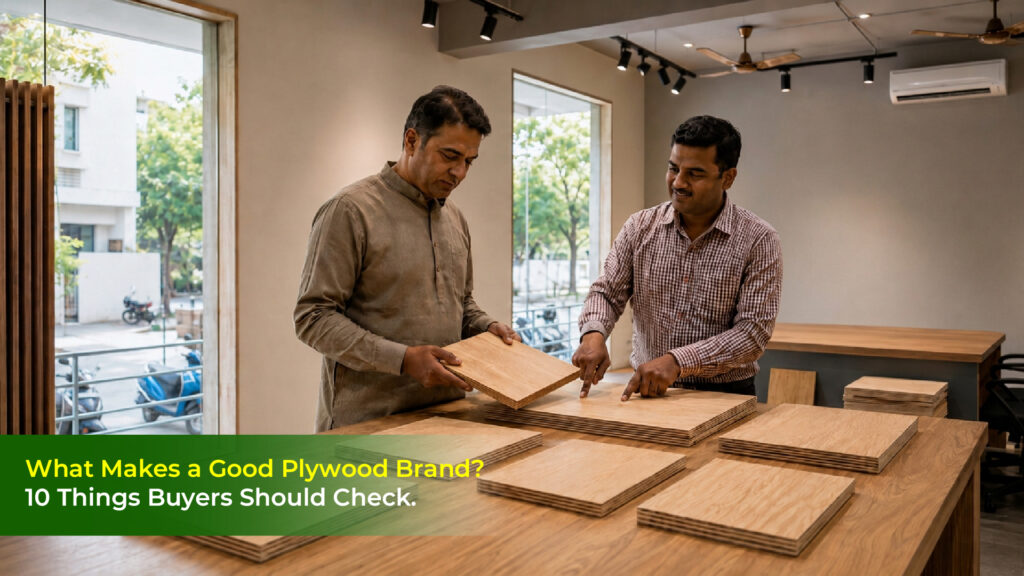
A good plywood brand is not defined by packaging or advertising alone. Buyers should look at manufacturing quality, testing, product consistency and how clearly the manufacturer communicates specifications.
Here are ten things worth checking before making a decision.
Plywood manufacturing involves several controlled processes. Veneer selection, seasoning, bonding, pressing, finishing and quality inspection all influence the final product.
A manufacturer with established production experience is more likely to have refined these processes through repeated testing and real-world application.
Experience also matters because plywood needs to perform across different climatic conditions and interior requirements.
However, years in the industry should be considered alongside actual manufacturing practices and quality controls.
Veneers form the basic building blocks of plywood.
Good-quality veneers should be properly seasoned and selected according to the intended product grade. Excessive defects, inconsistent thickness or poorly prepared veneers can affect the board’s structural performance.
Veneer quality also influences surface finish, dimensional stability and bonding.
For buyers, this means looking beyond the face veneer. The internal layers matter just as much.
The core is often overlooked because it is hidden after installation.
Yet core construction affects screw holding, bending performance and overall stability.
A well-constructed plywood core should have properly joined veneers with minimal gaps and reasonably consistent density.
This becomes particularly important for wardrobes, kitchen cabinets, shelves and furniture that carry repeated loads.
In practical use, poor core construction can eventually appear as loose hinges, weak screw joints or uneven surfaces.
A good plywood brand should offer clearly defined grades for different applications.
MR-grade plywood is generally intended for dry interior applications.
BWR and BWP grades provide greater resistance to moisture, with BWP plywood commonly selected for areas exposed to prolonged moisture.
For waterproof plywoods manufactured to relevant standards such as IS 710, the bonding system and test requirements are important considerations.
The key is not to choose the highest grade automatically. Choose the grade that matches the environment.
The adhesive system is central to plywood performance.
Veneers need to remain securely bonded when the board experiences changes in temperature, humidity and mechanical stress.
Different grades use different adhesive systems based on their intended performance.
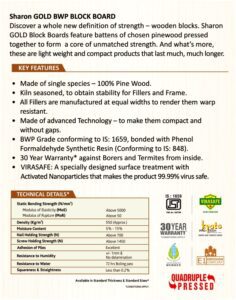
For example, phenol formaldehyde-based bonding systems are commonly associated with BWP-grade plywood because of their resistance to moisture exposure.
Buyers should understand what grade they are purchasing and whether its bonding system is appropriate for the application.
A reliable plywood brand should be able to demonstrate that its products are tested against relevant standards.
Indian Standards such as IS 303 and IS 710 specify requirements for different plywood categories and applications.
Testing may evaluate characteristics such as bond strength, water resistance, dimensional performance and other relevant properties depending on the product.
Certification alone does not tell the entire story, but it provides an important reference point for evaluating whether a product meets defined requirements.
For larger projects, professionals should also review available technical documentation and test reports.
One good plywood sheet is not enough.
For a kitchen, wardrobe or large commercial project, dozens or even hundreds of sheets may be required. Consistency between sheets becomes important for fabrication and installation.
Thickness variation, uneven surfaces or differences in core construction can create problems during machining and assembly.
A dependable manufacturer should maintain consistent production parameters so that the product behaves predictably across batches.
This is particularly relevant for CNC-based furniture manufacturing.
India’s climate varies significantly.
Coastal regions experience prolonged humidity. Monsoon-prone areas face seasonal moisture exposure. Other regions experience dry heat and significant temperature fluctuations.
Plywood should therefore be selected according to the conditions in which it will be used.
A good plywood brand should provide products suited to different exposure levels rather than treating every application in the same way.
At the same time, even waterproof ply woods require proper storage, edge sealing and installation. No grade can compensate for continuous water leakage or poor site practices.
Plywood is often used extensively inside homes, so adhesive emissions are worth considering.
Low-emission plywood products are manufactured using adhesive systems designed to control formaldehyde emissions.
Standards and classifications such as E1 and E0 are commonly referenced when evaluating emission performance, although the exact testing method and limits should always be verified from product documentation.
This consideration becomes particularly relevant in bedrooms, children’s spaces and other enclosed interiors.
Indoor air quality also depends on other materials, including laminates, paints and adhesives.
A good plywood brand should make product information easy to understand.
Buyers should be able to identify the product grade, thickness, intended application and relevant certifications.
Technical support can also be valuable when selecting materials for larger projects.
For homeowners, clear information makes it easier to have informed conversations with carpenters and contractors. For professionals, reliable documentation supports accurate material specification.
Transparency is ultimately a practical measure of how seriously a manufacturer approaches its products.
These ten factors do not carry equal importance for every project.
For a kitchen, moisture resistance and bonding quality may be the priority.
For a wardrobe, core construction, screw holding and dimensional stability may matter more.
For modular furniture, consistent thickness and maintainability become particularly relevant.
For bedrooms and enclosed interiors, emission performance may also influence the decision.
The right approach is to match the plywood specification to the actual application instead of choosing purely on brand reputation or price.
A reputable plywood brand goes beyond just its well-known name. It involves many factors including experience in manufacturing, quality of veneers, construction of cores, adhesion techniques, testing, consistency, and transparency in product specifications.
It is also essential to take into consideration the conditions under which the plywood would be subjected to moisture, loads, temperature, and normal use. The proper storage and workmanship are still relevant even when the proper product has been chosen.
The extensive experience of SharonPly in plywood manufacturing highlights the significance of consistency, quality, and application-specific choice of plywood. For both homeowners and professionals, the knowledge of what lies beneath the plywood plays an essential role in making purchase decisions.








Users understand that SHARONPLY is committed to protecting the User’s privacy and shall take all efforts to protect any personal data provided to the Website by reasonable security safeguards against such risks as loss or unauthorised use, destruction, modification or disclosure of data, However, in case of any lapse, SHARONPLY shall not be held responsible for any effect or consequences thereof. The Website uses cookies to track usage of the path of the User. Since most web browsers automatically accept cookies, User can edit User’s browser options to block them if User does not want the Website to use cookies to track usage of the path of the User.
SHARONPLY undertakes not to disclose, except as otherwise provided, the personal information provided by the User to any person, unless such action is necessary to: –
By filling up any form on the Website User automatically grants SHARONPLY a royalty-free, perpetual, irrevocable non-exclusive license to use, reproduce, publish, edit, distribute, and publicly display the information given in the form and to sublicense such rights.
Any queries regarding the SHARONPLY’s privacy policy, may be sent to admin@sharonply.com.