
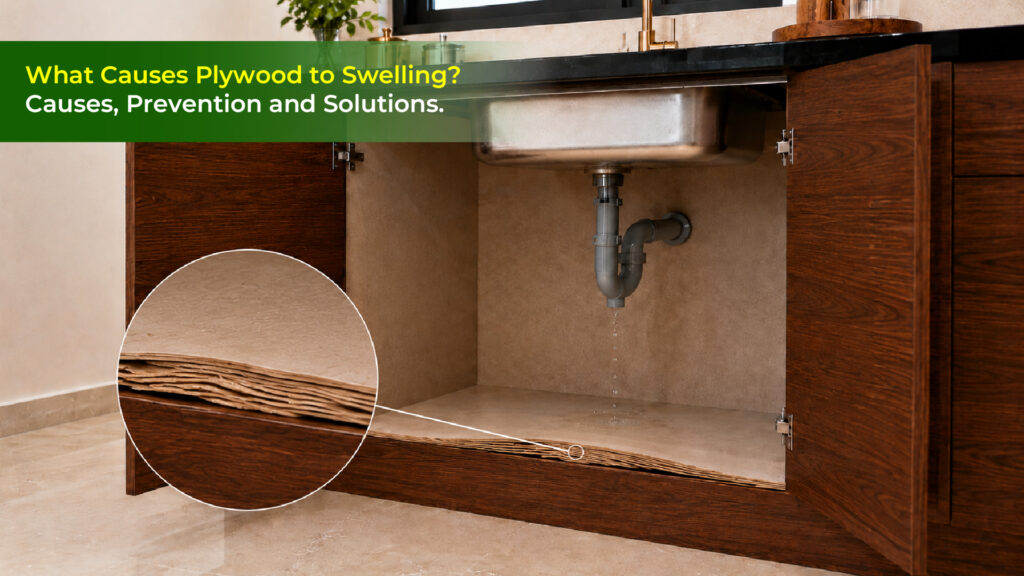
Plywood is designed to remain stable under normal interior conditions, but prolonged exposure to moisture can change its dimensions. Swelling is one of the most common signs of moisture-related plywood damage.
It can appear as raised edges, uneven surfaces, tight cabinet shutters or gaps between furniture components. In severe cases, swelling can affect the structural integrity of the board.
Understanding why plywood swells is important because the problem is not always caused by poor-quality material. Plywood grade, moisture exposure, core construction, storage and installation practices can all play a role.
Plywood swells when its wood veneers absorb moisture from the surrounding environment. Wood is hygroscopic, which means it naturally absorbs and releases moisture depending on humidity conditions.
Some amount of dimensional movement is normal. Problems arise when plywood is exposed to excessive or prolonged moisture.
Common causes include:
Water leaks are one of the most obvious causes.
Kitchen sink cabinets, utility areas and furniture near plumbing are particularly vulnerable. A small leak that remains unnoticed can allow water to penetrate the exposed edges of plywood.
Once moisture enters the board, the wood fibres can expand. Repeated wetting and drying can increase dimensional changes and may eventually affect the adhesive bond.
This is where material choice matters. Areas exposed to regular moisture require plywood with an appropriate moisture-resistant specification.
Plywood does not need to come into direct contact with water to absorb moisture.
In coastal cities and monsoon-prone regions, high atmospheric humidity can increase the moisture content of wood-based panels.
Closed cabinets with limited airflow can be particularly affected.
Humidity alone does not necessarily cause severe swelling, but prolonged exposure combined with poor ventilation can contribute to dimensional instability over time.
Different plywood grades are designed for different environmental conditions.
MR-grade plywood is generally intended for dry interior applications. It offers reasonable moisture resistance but is not designed for prolonged water exposure.
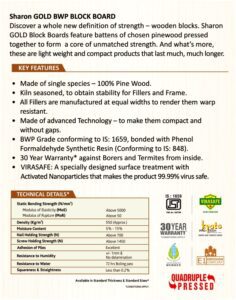
BWR and BWP grades provide greater resistance to moisture. Waterproof plywoods manufactured to standards such as IS 710 are generally preferred for areas with higher moisture exposure.
Using a dry-area grade in a wet application can increase the risk of swelling.
Not all plywood reacts to moisture in the same way.
Core construction has an important role in dimensional stability.
Well-constructed plywood uses properly seasoned veneers with controlled moisture content and consistent bonding. Poorly constructed cores may contain excessive gaps, uneven density or improperly prepared veneers.
When moisture enters such areas, different sections of the board may respond differently.
This can result in uneven swelling, warping or surface irregularities.
In practical use, core quality becomes especially important in furniture that carries loads or receives frequent hardware movement.
Yes.
Plywood can absorb moisture before it is even installed.
Storing sheets directly on a damp floor exposes the bottom layers to moisture. Leaving boards uncovered during rain can also increase moisture absorption.
Temperature and humidity changes during storage may contribute to dimensional movement.
The solution is straightforward. Plywood should be stored horizontally on a level, raised surface in a dry and reasonably ventilated area. It should also be protected from direct rain and excessive moisture.
Good storage preserves the properties established during manufacturing.
Prevention begins with matching the plywood to the application.
For kitchens, sink units and other moisture-prone areas, waterproof plywoods with suitable BWP-grade bonding offer greater resistance to moisture-related problems.
However, product selection is only one part of prevention.
Cut edges can provide an easier path for moisture to enter the plywood.
Edge sealing, edge banding or suitable finishing systems help reduce moisture penetration.
This is particularly important around sinks, counter tops and plumbing openings.
Proper plumbing installation and routine maintenance are equally important.
Even waterproof plywood can eventually be affected by continuous standing water or an unresolved leak.
Cabinet bases should be designed to minimize direct water contact wherever possible.
Closed spaces can trap moisture.
Providing adequate airflow around enclosed furniture can help reduce prolonged humidity exposure.
This is particularly useful for wardrobes positioned against exterior walls or furniture installed in poorly ventilated areas.
The solution depends on the severity of the damage.
If the swelling is minor and caused by temporary surface moisture, allowing the material to dry completely may prevent further deterioration. The moisture source should be identified and corrected first.
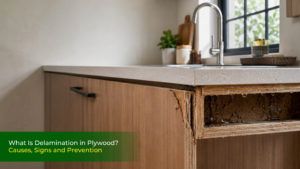
However, if the plywood has significantly expanded, delaminated or lost its shape, drying alone may not restore its original dimensions.
In such cases, replacing the affected component may be more practical.
Simply covering swollen plywood with a new laminate does not solve the underlying problem.
No.Waterproof plywood is mostly associated with the wood’s ability to resist moisture and bonding under test conditions. This does not mean that the wood material is totally immune to water.
The BWP (Boiling Water Proof) plywood produced according to standards is capable of keeping bonds in adverse moisture conditions. Nonetheless, the swelling may occur in case of total immersion in water or insufficient edge protection.
This information will be helpful in setting reasonable expectations.
Indian homes experience disparate environmental conditions.
A plywood specification that works well in a dry bedroom may not be appropriate for a sink cabinet in a coastal home.
Before choosing plywood, consider:
This approach avoids both unnecessary over-specification and cost-driven material substitution.
It is not possible for good quality plywood to rectify poor craftsmanship.
Faulty screw positioning, unsealed seams, gaps in areas where plumbing is done and improper lamination may cause water seepage.
There are differences in carpentry skills from place to place; therefore, proper supervision and finishing are essential.
As time passes, proper craftsmanship ensures the optimal functioning of the plywood.
Plywood swelling is primarily a moisture-related problem, but moisture can enter through several routes. Direct water exposure, humidity, poor storage, unsuitable grades and inadequate edge protection can all contribute.
The most effective solution is to match plywood to the environment, use appropriate moisture-resistant or waterproof plywoods where necessary, protect exposed edges and maintain good installation practices.
At SharonPly, years of experience across India’s varied climates have reinforced a simple principle. Plywood performs best when the material, application and installation conditions are considered together.







Users understand that SHARONPLY is committed to protecting the User’s privacy and shall take all efforts to protect any personal data provided to the Website by reasonable security safeguards against such risks as loss or unauthorised use, destruction, modification or disclosure of data, However, in case of any lapse, SHARONPLY shall not be held responsible for any effect or consequences thereof. The Website uses cookies to track usage of the path of the User. Since most web browsers automatically accept cookies, User can edit User’s browser options to block them if User does not want the Website to use cookies to track usage of the path of the User.
SHARONPLY undertakes not to disclose, except as otherwise provided, the personal information provided by the User to any person, unless such action is necessary to: –
By filling up any form on the Website User automatically grants SHARONPLY a royalty-free, perpetual, irrevocable non-exclusive license to use, reproduce, publish, edit, distribute, and publicly display the information given in the form and to sublicense such rights.
Any queries regarding the SHARONPLY’s privacy policy, may be sent to admin@sharonply.com.