
Fire safety is commonly talked about in the context of alarms, fire extinguishers, and electrical design. Interior materials are not commonly mentioned.
However, in contemporary homes, a substantial area of interior surfaces is typically made of wood-based panels. Closets, kitchen cabinets, wall paneling, TV stands, and partitions are common examples of plywood or engineered wood use.
This is where the choice of material becomes important.
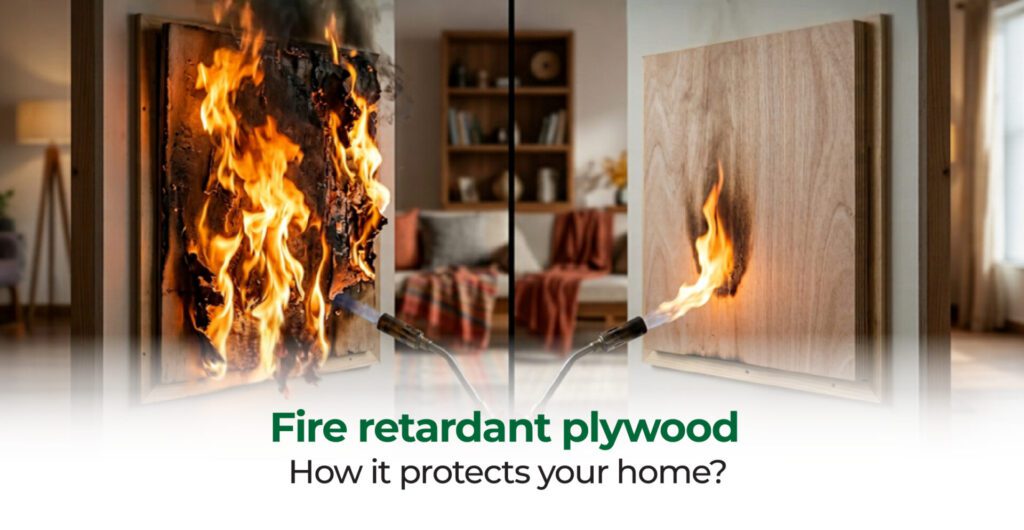
Fire-resistant plywood is meant to resist the spread of fire. It does not make a house fireproof. It enhances response time and resists the spread of fire over surfaces. In reality, this can be a big difference.
Fire retardant plywood is a plywood that has been treated with special chemicals to reduce its flammability and surface spread of flame.
The base construction remains similar to regular plywood. Veneers are cross-laminated and bonded under heat and pressure. The difference lies in the fire-retardant treatment, which can be applied through pressure impregnation or surface treatment during manufacturing.
In India, fire retardant plywood is generally tested as per IS 5509, which evaluates characteristics such as surface spread of flame, rate of burning and flammability.
The purpose is clear. When exposed to fire, the material should:
It buys time. It does not eliminate risk.
Fire retardant treatment changes how the wood reacts under heat.
When exposed to high temperatures, untreated wood releases combustible gases that sustain flame. Fire retardant chemicals promote the formation of a protective char layer. This char insulates the inner layers and slows further combustion.
Some treatments also reduce the amount of flammable gases released during burning.
In practical use, this means that flames do not travel as quickly across a fire retardant plywood surface compared to untreated boards.
Over time, this difference becomes noticeable in controlled fire testing environments. Flame spread is slower and more contained.
No plywood is completely fireproof.
Even fire retardant plywood is still wood-based. Under sustained high temperatures, it will burn.
The purpose of fire retardant treatment is to delay ignition and limit surface spread, not to prevent combustion entirely.
For homeowners, this distinction is important. Fire retardant plywood is a safety enhancement. It is not a replacement for proper electrical design, circuit protection and smoke detection systems.
Balanced expectations lead to better decisions.
Not every room requires fire retardant material.
However, certain areas carry higher risk:
In apartments with compact layouts, electrical wiring often runs behind plywood partitions and false panels. In such situations, specifying fire retardant plywood adds an extra layer of safety.
In commercial buildings, fire safety norms may require materials with controlled flame spread properties. Architects often review compliance documents before specifying.
This is where technical understanding becomes essential.
Fire performance and moisture resistance are separate characteristics.
Waterproof plywoods, such as BWP grade boards under IS 710, are designed primarily for moisture resistance. They use phenol formaldehyde resin for strong bonding under wet conditions.
Fire retardant plywood focuses on flame resistance.
Some products on the market combine both properties. However, performance depends on the manufacturing process and certification. One should not assume that all waterproof plywoods are fire retardant, or vice versa.
In kitchens, for example, moisture exposure is high. In such areas, both moisture resistance and fire safety may need to be evaluated based on design and risk assessment.
Clear specification avoids confusion later.
Fire retardant treatment does not compensate for poor core construction.
If the plywood core contains gaps or low-density filler material, screw holding capacity and structural stability will still be compromised. The fire treatment affects reaction to heat, not mechanical strength.
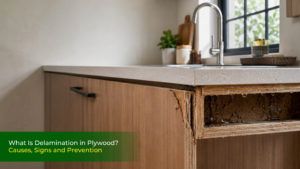
Bonding quality also remains critical. In humid Indian climates, poor bonding can lead to delamination over time.
This is why certification and testing are important. Fire retardant plywood should comply with relevant Indian Standards, and base plywood quality should meet structural requirements.
One feature should not replace the other.
Indian climates vary widely. High humidity in coastal cities, dry heat in interior regions and seasonal monsoons all affect plywood behaviour.
Fire retardant treatment can sometimes make boards slightly more sensitive to moisture if not properly sealed. Proper edge sealing and finishing are essential.
Storage on site also matters. Boards should be stacked on raised platforms and protected from direct rain before installation.
In practical use, poor storage can damage even high-grade materials before they are fitted.
Material performance is a combination of manufacturing quality and site handling.
Some homeowners worry whether fire retardant chemicals increase indoor emissions.
Reputable manufacturers design fire retardant plywood to comply with formaldehyde emission norms such as E0 standards. Adhesive systems and chemical treatments are engineered to meet regulatory limits.
However, indoor air quality depends on the complete interior system. Laminates, adhesives used for pasting and edge banding materials also contribute.
It is advisable to review certification documents and emission test reports when selecting fire retardant panels for residential use.
Transparency builds trust.
Fire-resistant plywood tends to be more expensive than regular plywood of the same thickness.
In certain residential applications, full-house treatment may not be required. Strategic treatment in high-risk areas may be a sound strategy.
In commercial applications, requirements for compliance will determine the choice of materials.
Cost considerations must be tied to risk assessment, rather than purely financial objectives. The potential consequences of fire diffusion in high-density urban residential areas make fire prevention more pertinent in the current era than in the past.
In real-world applications, upfront planning is more cost-effective than retrofits.
Installation procedures affect performance.
Overloading electrical wiring is not advisable. Proper ventilation around appliances that generate heat will help. Edges that are cut should be sealed after fabrication.
The level of carpentry skill and supervision is not standard. Proper installation is the final link in the safety chain.
Protection cannot be guaranteed by material selection alone.
Fire retardant plywood is not about creating fear. It is about informed planning.
Homes today include more electrical devices, modular kitchens and entertainment systems than ever before. The load on interior surfaces has increased.
Choosing fire retardant plywood in appropriate areas slows flame spread and enhances response time in case of an incident. It is one part of a broader fire safety strategy that includes wiring quality, protective devices and detection systems.
At SharonPly, with decades of experience across residential and commercial projects in India, we have seen how material choices influence long-term safety and performance. Fire retardant plywood, when specified correctly and installed responsibly, adds a meaningful layer of protection.









Users understand that SHARONPLY is committed to protecting the User’s privacy and shall take all efforts to protect any personal data provided to the Website by reasonable security safeguards against such risks as loss or unauthorised use, destruction, modification or disclosure of data, However, in case of any lapse, SHARONPLY shall not be held responsible for any effect or consequences thereof. The Website uses cookies to track usage of the path of the User. Since most web browsers automatically accept cookies, User can edit User’s browser options to block them if User does not want the Website to use cookies to track usage of the path of the User.
SHARONPLY undertakes not to disclose, except as otherwise provided, the personal information provided by the User to any person, unless such action is necessary to: –
By filling up any form on the Website User automatically grants SHARONPLY a royalty-free, perpetual, irrevocable non-exclusive license to use, reproduce, publish, edit, distribute, and publicly display the information given in the form and to sublicense such rights.
Any queries regarding the SHARONPLY’s privacy policy, may be sent to admin@sharonply.com.