
Interior damage rarely happens overnight. It builds gradually. A small moisture patch. A minor leak. A hidden termite entry point. These early signs often go unnoticed until the damage becomes visible and expensive to repair.
In Indian homes, where humidity, temperature variation and construction practices vary widely, protecting interiors requires a combination of the right materials and correct execution.
Avoiding termites, moisture and long-term damage is not about a single solution. It is about understanding how these factors interact and how plywood and other materials respond to them over time.
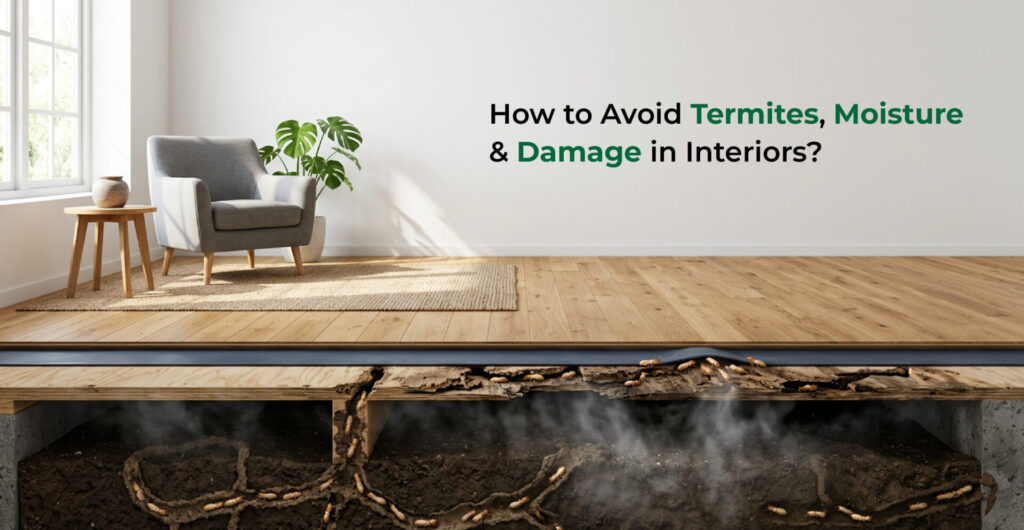
Termites and moisture are often linked. Damp conditions create a favourable environment for termite activity. At the same time, moisture weakens materials, making them more vulnerable to infestation.
Wood-based materials, including plywood, are particularly affected when exposed to prolonged humidity or water seepage.
In practical use, damage usually begins in concealed areas such as under-sink cabinets, wardrobes against damp walls or poorly ventilated corners.
This is where material choice matters.
The first level of protection comes from selecting the appropriate plywood grade.
MR grade plywood is suitable for dry areas. For spaces with moderate humidity, BWR grade provides better resistance. In high-moisture environments, waterproof plywoods such as BWP grade offer stronger bonding and improved durability.
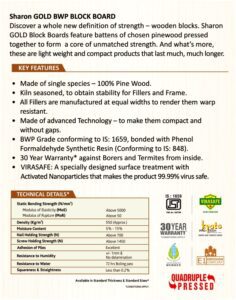
BWP plywood is manufactured using phenol-formaldehyde adhesives and tested under IS 710 standards. It includes rigorous testing like 72-hour boiling water resistance, ensuring durability in wet conditions.
This ensures that the bonding remains stable even under prolonged exposure to moisture. While no plywood is completely immune to termites or water damage, higher-grade plywood reduces the likelihood of early failure.
Many plywood products are treated with preservatives to improve resistance against termites and borers. These treatments penetrate the wood layers and make them less attractive to pests.
However, it is important to understand that termite resistance is not absolute. It depends on the quality of treatment, storage conditions and surrounding environment.
In areas with known termite activity, additional anti-termite treatment at the construction stage is often recommended.
Over time, this layered approach proves more effective than relying on a single solution.
Moisture is one of the most common causes of interior damage. It enters through leaks, poor waterproofing, condensation and even ambient humidity.
Controlling moisture begins at the structural level. Proper waterproofing of walls, floors and plumbing systems reduces the risk of seepage.
In practical use, even small leaks under sinks or behind cabinets can lead to long-term damage if left unattended.
Good ventilation also plays a role. Air circulation helps reduce humidity levels and prevents moisture from settling within enclosed spaces.
Plywood surfaces are usually protected with laminates or veneers, but edges are more vulnerable.
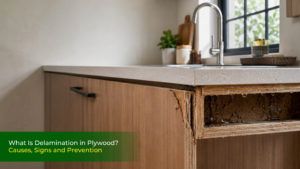
Unsealed edges absorb moisture faster, leading to swelling and internal weakening. This often becomes visible at joints and corners.
Applying edge banding, sealants or protective coatings helps reduce this risk.
This is a simple step, but it has a significant impact on long-term performance.
Even high-quality plywood can be compromised if stored incorrectly.
Sheets should be kept in dry, elevated areas, away from direct contact with damp floors or walls. Exposure to moisture before installation affects dimensional stability and bonding performance.
In practical use, this becomes noticeable when panels warp or show uneven surfaces soon after installation.
Proper handling ensures that the original quality of the material is maintained.
Workmanship plays a major role in preventing damage.
Accurate cutting, tight joinery and correct hardware installation reduce gaps where moisture or pests can enter. Poorly fitted joints or exposed edges often become starting points for damage.
In addition, allowing slight clearances for expansion helps plywood accommodate changes in humidity without stress.
This is where experienced carpentry makes a clear difference.
Interiors require periodic checks, especially in moisture-prone areas.
Inspecting under-sink cabinets, checking for plumbing leaks and monitoring damp spots helps identify issues early. Termite activity often starts in hidden areas and spreads gradually.
In practical use, early detection reduces repair costs and prevents structural damage.
Maintenance is not complex, but it needs consistency.
A common belief is that waterproof plywood eliminates all moisture-related risks. In reality, it improves resistance but does not replace proper waterproofing or maintenance.
Another misconception is that termite-resistant plywood does not require additional treatment. While it offers protection, environmental factors still influence infestation risk.
There is also an assumption that thicker plywood is always safer. Thickness contributes to strength, but core quality and bonding are equally important.
Understanding these points helps set realistic expectations.
Not every part of an interior requires the highest grade of plywood. Using BWP plywood selectively in kitchens, bathrooms and utility areas ensures better protection where it is needed most.
For dry areas, MR or BWR grades may perform adequately when chosen and installed correctly.
Balancing cost and application leads to more efficient use of materials without compromising durability.
Avoiding termites, moisture and damage is a combination of informed choices and careful execution. Material selection, moisture control, proper installation and regular maintenance all contribute to long-term performance.
With experience across varied Indian conditions, SharonPly has seen that most interior issues can be prevented at the planning stage. When the right materials are chosen and used appropriately, interiors remain stable, functional and reliable for years.





Users understand that SHARONPLY is committed to protecting the User’s privacy and shall take all efforts to protect any personal data provided to the Website by reasonable security safeguards against such risks as loss or unauthorised use, destruction, modification or disclosure of data, However, in case of any lapse, SHARONPLY shall not be held responsible for any effect or consequences thereof. The Website uses cookies to track usage of the path of the User. Since most web browsers automatically accept cookies, User can edit User’s browser options to block them if User does not want the Website to use cookies to track usage of the path of the User.
SHARONPLY undertakes not to disclose, except as otherwise provided, the personal information provided by the User to any person, unless such action is necessary to: –
By filling up any form on the Website User automatically grants SHARONPLY a royalty-free, perpetual, irrevocable non-exclusive license to use, reproduce, publish, edit, distribute, and publicly display the information given in the form and to sublicense such rights.
Any queries regarding the SHARONPLY’s privacy policy, may be sent to admin@sharonply.com.