
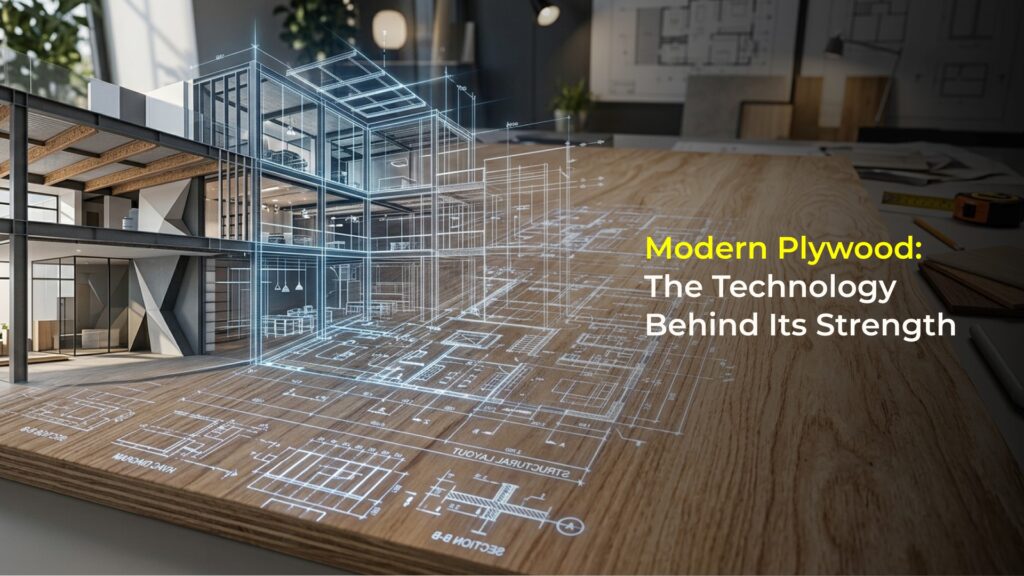
Plywood has been used in Indian interiors for decades, but the material itself has evolved significantly over time. Modern plywood is no longer just a basic wood panel used for cabinets or furniture. Today, it is an engineered product designed to handle changing climates, heavier usage and more demanding interior applications.
Its strength comes not only from the wood itself, but from the technology involved in manufacturing, bonding and treatment processes.
Understanding how modern plywood is made helps explain why some boards perform consistently for years while others show signs of damage much earlier.
Plywood is manufactured by bonding thin layers of wood veneers together under heat and pressure. These layers are placed with alternating grain directions, which improves dimensional stability and reduces the natural movement found in solid wood.
This cross-layered structure distributes stress more evenly across the board. As a result, plywood is less likely to crack, split or warp under normal interior conditions.
In practical use, this becomes noticeable in furniture that remains stable despite changes in humidity or seasonal temperature variations.
This is where engineered construction makes a difference.
The strength of plywood begins with the quality of the veneers used in its core and surface layers.
Modern manufacturing processes focus on selecting veneers with controlled moisture content and consistent thickness. Properly dried veneers reduce internal stress within the panel and improve bonding performance.
Lower-quality veneers often contain knots, overlaps or uneven grain structures. Over time, these irregularities affect load-bearing capacity and dimensional stability.
In practical use, poor veneer quality may lead to sagging shelves, surface unevenness or internal weakening.
One of the most important advancements in plywood manufacturing is adhesive technology.
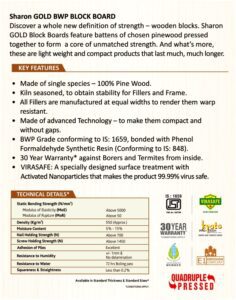
Modern plywood uses different resin systems depending on the intended application. MR grade plywood commonly uses urea-formaldehyde adhesives, while BWR and waterproof plywoods such as BWP grade rely on phenol-formaldehyde resins for stronger moisture resistance.
These adhesives are designed to maintain bonding integrity under heat, humidity and changing environmental conditions.
In India, BWP plywood is tested under IS 710 standards to evaluate its resistance to prolonged water exposure.
However, adhesive performance also depends on correct glue spread, press pressure and curing cycles during manufacturing. This is why production consistency matters as much as the adhesive itself.
Pressing is one of the most critical stages in plywood manufacturing.
Modern hydraulic press systems apply controlled heat and pressure to bond the veneers into a single stable panel. Uniform pressing ensures that the adhesive spreads evenly and that the layers remain compact.
If pressure is inconsistent, internal gaps or weak bonding zones may develop.
Over time, this becomes noticeable when panels begin to separate or lose structural stability under stress.
Controlled pressing technology helps reduce these risks and improves overall panel strength.
The internal core of plywood plays a major role in determining how much load it can handle.
High-quality plywood uses compact core construction with minimal gaps between veneers. This improves screw holding capacity and overall durability.
In practical use, strong core construction allows cabinets, shelves and furniture to handle everyday weight without deformation.
This is especially important in modular interiors where plywood supports both structural load and hardware fittings.
Modern plywood technology also focuses heavily on moisture management.
Wood naturally absorbs and releases moisture depending on environmental conditions. Good plywood is designed to minimize the impact of this movement.
Waterproof plywoods use stronger bonding systems and controlled veneer treatment to improve resistance against swelling and delamination. This makes them suitable for kitchens, bathrooms and utility areas where humidity levels fluctuate regularly.
Simultaneously, proper installation and edge sealing remain essential. Even advanced plywood performs best when moisture exposure is controlled.
Earlier plywood manufacturing often depended heavily on manual processes. Modern production uses greater automation and quality monitoring to improve consistency.
Precision cutting, calibrated pressing and moisture-controlled storage help ensure that each board performs within expected standards.
This consistency becomes important in large projects where multiple panels must behave similarly after installation.
In practical use, inconsistent plywood often leads to uneven finishes, varying thickness levels or installation difficulties.
Modern interiors increasingly focus on indoor air quality along with durability.
Plywood manufacturers now pay closer attention to adhesive emissions and environmental standards. Low-emission formulations help reduce indoor air pollutants, particularly in enclosed residential spaces.
Certifications related to formaldehyde emissions provide additional assurance regarding indoor suitability.
This aspect is becoming more relevant as homes adopt compact layouts with reduced natural ventilation.
Even technologically advanced plywood depends on proper workmanship.
Accurate cutting, correct joinery and edge protection influence how the material performs after installation. Improper storage on site or exposure to moisture before fixing can affect dimensional stability.
This is often overlooked during projects. However, installation quality has a direct impact on long-term durability.
Technology improves performance, but execution still matters.
A common assumption is that thicker plywood is always stronger. While thickness contributes to load-bearing capacity, core quality and bonding consistency are equally important.
Another misconception is that all waterproof plywoods perform the same. Manufacturing standards, veneer selection and adhesive control create noticeable differences between products.
There is also a belief that engineered plywood lacks the durability of solid wood. In reality, properly manufactured plywood often performs more consistently under fluctuating climatic conditions.
Understanding these distinctions helps in making more informed decisions.
The strength of modern plywood comes from a combination of engineering, material science and manufacturing precision. Veneer selection, bonding technology, pressing systems and moisture control all work together to improve performance.
At the same time, even the best plywood depends on correct application and installation practices.
With years of experience across Indian climates and construction conditions, SharonPly has seen that durable interiors are built on informed material choices. When plywood is selected based on actual usage conditions and manufactured with consistency, it supports interiors that remain stable, functional and dependable over time.








Users understand that SHARONPLY is committed to protecting the User’s privacy and shall take all efforts to protect any personal data provided to the Website by reasonable security safeguards against such risks as loss or unauthorised use, destruction, modification or disclosure of data, However, in case of any lapse, SHARONPLY shall not be held responsible for any effect or consequences thereof. The Website uses cookies to track usage of the path of the User. Since most web browsers automatically accept cookies, User can edit User’s browser options to block them if User does not want the Website to use cookies to track usage of the path of the User.
SHARONPLY undertakes not to disclose, except as otherwise provided, the personal information provided by the User to any person, unless such action is necessary to: –
By filling up any form on the Website User automatically grants SHARONPLY a royalty-free, perpetual, irrevocable non-exclusive license to use, reproduce, publish, edit, distribute, and publicly display the information given in the form and to sublicense such rights.
Any queries regarding the SHARONPLY’s privacy policy, may be sent to admin@sharonply.com.