

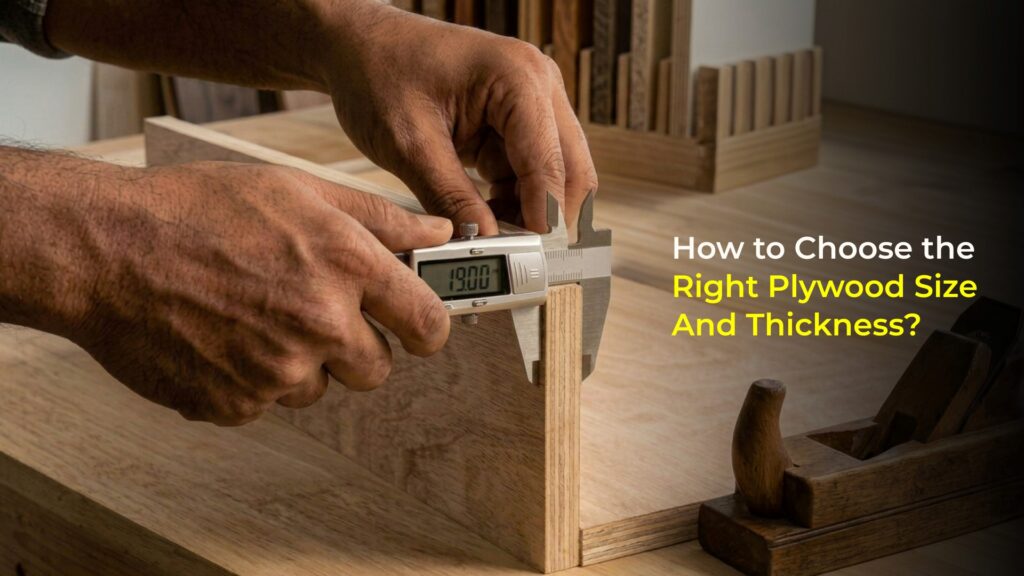
Choosing plywood is not only about selecting the right grade. Size and thickness play an equally important role in how interiors perform over time. Even high-quality plywood can under perform if the dimensions are not suited to the application.
In many projects, plywood thickness is chosen based on availability or cost alone. However, different interior applications place different demands on the material. Cabinets, wardrobes, partitions and furniture all require different levels of strength and stability.
Understanding how plywood size and thickness affect performance helps create interiors that remain functional and durable for years.
Thickness directly influences strength, load-bearing capacity and dimensional stability.
Thicker plywood generally offers better resistance to bending and sagging. However, using excessive thickness in every application may increase weight and cost unnecessarily.
In practical use, the right thickness depends on how the plywood will be supported, the amount of load it will carry and the environmental conditions around it.
This is where material choice matters. Thickness should match actual usage, not assumptions.
Plywood is available in multiple thickness options, each suited to specific applications.
6 mm plywood is commonly used for lightweight partitions, curved designs and back panels. It works well where structural load is minimal.
9 mm plywood is often used for wall paneling, drawer bottoms and lightweight furniture sections.
12 mm plywood provides better rigidity and is suitable for smaller shelves, partitions and shutters.
16 mm to 18 mm plywood is widely preferred for wardrobes, kitchen cabinets and structural furniture components. This range offers a good balance of strength and work ability.
For heavy-duty applications or larger spans, thicker plywood may be considered depending on the design.
Over time, selecting insufficient thickness becomes noticeable through sagging shelves or unstable furniture.
The most commonly used plywood sheet size in India is 8 feet by 4 feet. This size works efficiently for modular furniture, wardrobes and interior paneling.
However, size selection should also consider wastage and design layout. Larger furniture pieces may require planning to reduce joints and material loss.
In practical use, poorly planned sizing increases cutting wastage and affects finishing consistency.
This is especially relevant in modular interiors where alignment and uniformity are important.
Environmental conditions influence plywood performance as much as structural load.
In kitchens and bathrooms, moisture exposure places additional stress on plywood. Thicker boards combined with waterproof plywoods such as BWP grade improve dimensional stability in these conditions.
For dry spaces like bedrooms or study areas, standard thickness with suitable grades may perform adequately.
This is where climate and application work together. A thickness suitable in one room may not be ideal in another.
Shelf length affects how plywood behaves under weight.
Longer shelves carrying books, kitchen utensils or storage loads require stronger support and adequate thickness. Thin plywood over wide spans tends to bend gradually over time.
In practical use, this becomes noticeable first at the center of the shelf.
Proper support spacing and core quality are equally important. Even thick plywood can weaken if the internal construction is poor.
Balanced design improves long-term stability.
Thickness alone does not guarantee strength.
The internal core structure determines how effectively the plywood handles stress. High-quality plywood uses compact veneers with minimal gaps. This improves screw holding capacity and load distribution.
Lower-quality boards may appear thick externally but contain weak internal sections.
Over time, this affects durability more than thickness itself.
This is why experienced carpenters often inspect the core before finalizing material selection.
Thicker plywood increases the overall weight of furniture and shutters.
This affects hardware performance, especially in modular kitchens and wardrobes where hinges and channels handle repeated movement.
Using unnecessarily heavy boards can place excess stress on fittings over time.
In practical use, balanced thickness improves both durability and ease of operation.
Proper hardware selection should always match the plywood weight and intended usage.
Many homeowners assume that thicker plywood automatically offers better moisture resistance. In reality, moisture resistance depends more on adhesive quality and manufacturing standards than thickness alone.
Waterproof plywood’s use stronger bonding systems that help maintain stability in humid conditions. However, even these require proper edge sealing and finishing.
Thickness supports structural stability, while bonding quality controls resistance to moisture-related damage.
Understanding this distinction helps avoid common misconceptions.
Thicker plywood requires proper handling during transportation and installation.
Large heavy boards may develop stress if stored unevenly or lifted incorrectly. Sheets should be stored flat in dry areas to maintain dimensional stability before installation.
Carpentry skill also plays a role. Accurate cutting and edge sealing improve the performance of plywood regardless of thickness.
This is often overlooked, but workmanship significantly influences long-term results.
Selecting plywood thickness is ultimately about balance.
Using higher thickness everywhere increases cost and weight without always improving performance. Simultaneously, reducing thickness beyond practical limits often leads to early wear and instability.
The best results come from matching thickness to the application, environmental conditions and design requirements.
With years of experience across different interior applications, SharonPly has seen that thoughtful material selection creates interiors that remain stable and functional over time. When plywood size and thickness are chosen with clarity, they support better performance, smoother installation and long-term reliability.








Users understand that SHARONPLY is committed to protecting the User’s privacy and shall take all efforts to protect any personal data provided to the Website by reasonable security safeguards against such risks as loss or unauthorised use, destruction, modification or disclosure of data, However, in case of any lapse, SHARONPLY shall not be held responsible for any effect or consequences thereof. The Website uses cookies to track usage of the path of the User. Since most web browsers automatically accept cookies, User can edit User’s browser options to block them if User does not want the Website to use cookies to track usage of the path of the User.
SHARONPLY undertakes not to disclose, except as otherwise provided, the personal information provided by the User to any person, unless such action is necessary to: –
By filling up any form on the Website User automatically grants SHARONPLY a royalty-free, perpetual, irrevocable non-exclusive license to use, reproduce, publish, edit, distribute, and publicly display the information given in the form and to sublicense such rights.
Any queries regarding the SHARONPLY’s privacy policy, may be sent to admin@sharonply.com.