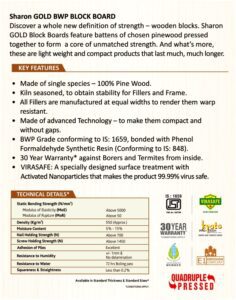


Buying plywood may seem straightforward at first. Most boards look similar on the surface, and pricing often becomes the deciding factor. However, performance differences only become visible after installation, when repairs are more difficult and expensive.
In Indian conditions, where humidity, temperature and usage vary across regions, selecting the right plywood requires a closer look. A few practical checks at the purchase stage can prevent long-term issues.
This guide brings together five key considerations that professionals rely on before choosing plywood for interiors.
Plywood grades are defined mainly by bonding strength and moisture resistance.
MR grade plywood is suitable for dry areas such as bedrooms and living spaces. BWR grade offers better resistance and is commonly used in kitchens. BWP grade, often referred to as waterproof plywoods, is designed for high-moisture areas like bathrooms and under-sink units.
In practical use, choosing a higher grade than required may not always be necessary. Simultaneously, using a lower grade in moisture-prone areas leads to early damage.
This is where material choice matters. The right grade should match the actual conditions the plywood will face.
Authentic plywood is manufactured under controlled conditions and tested for performance.
In India, standards such as IS 303 for BWR grade and IS 710 for BWP grade define bonding requirements. ISI certification indicates that the product meets these specifications.
Markings are usually stamped on the board. However, they should be read along with the source of purchase. Reliable suppliers and consistent branding help ensure authenticity.
In practical use, certified plywood provides more predictable performance, especially in demanding environments.
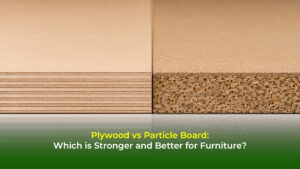
The core of plywood determines its strength and durability.
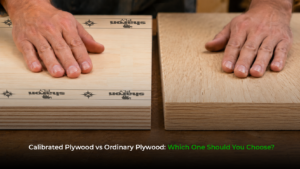
High-quality plywood uses evenly arranged veneers with minimal gaps. The layers should appear compact and uniform when viewed along the edges.
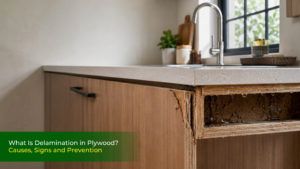
Lower-quality boards often have visible voids or overlaps. These gaps weaken the structure and allow moisture to collect inside.
Over time, this becomes noticeable in the form of surface deformation, reduced load-bearing capacity or internal failure.
A quick edge inspection can reveal more than surface appearance.
Thickness is often associated with strength, but it should be chosen based on application.
For cabinets and wardrobes, 18 mm plywood is commonly used for structural sections. Thinner boards may be suitable for partitions or back panels.
Density also matters. Good plywood feels solid and balanced when handled. Extremely lightweight boards may indicate lower core density.
In practical use, incorrect thickness or density leads to sagging shelves, misaligned shutters and reduced stability over time.
Balancing thickness with load requirements ensures better performance.
Plywood performance does not depend only on manufacturing. Handling and installation play an equally important role.
Sheets should be stored in dry, well-ventilated areas before use. Exposure to damp floors or walls can affect dimensional stability.
Carpentry practices also influence durability. Proper cutting, edge sealing and accurate joinery reduce the risk of moisture entry and structural stress.
Even high-quality plywood can under perform if installation is not handled carefully.
This is often overlooked during planning, but it has a lasting impact.
Many buyers assume that waterproof plywood can be used everywhere. While it offers better resistance, it is most effective when used in moisture-prone areas.
Another common belief is that branded plywood automatically guarantees quality. While brand reputation helps, it should still be supported by certification and inspection.
There is also a tendency to focus only on price. Lower cost may indicate compromises in core quality or bonding, which affect long-term performance.
Understanding these points helps in making more balanced decisions.
Buying plywood is not just a material decision. It is a long-term investment in how interiors perform.
The right grade, certified manufacturing, strong core construction, appropriate thickness and proper handling all contribute to durability. When these factors are considered together, the chances of failure reduce significantly.
With decades of experience across varied applications and climates, SharonPly has seen that careful selection at the purchase stage prevents most issues later. When plywood is chosen with clarity and used appropriately, it supports interiors that remain stable, functional and reliable over time.







Users understand that SHARONPLY is committed to protecting the User’s privacy and shall take all efforts to protect any personal data provided to the Website by reasonable security safeguards against such risks as loss or unauthorised use, destruction, modification or disclosure of data, However, in case of any lapse, SHARONPLY shall not be held responsible for any effect or consequences thereof. The Website uses cookies to track usage of the path of the User. Since most web browsers automatically accept cookies, User can edit User’s browser options to block them if User does not want the Website to use cookies to track usage of the path of the User.
SHARONPLY undertakes not to disclose, except as otherwise provided, the personal information provided by the User to any person, unless such action is necessary to: –
By filling up any form on the Website User automatically grants SHARONPLY a royalty-free, perpetual, irrevocable non-exclusive license to use, reproduce, publish, edit, distribute, and publicly display the information given in the form and to sublicense such rights.
Any queries regarding the SHARONPLY’s privacy policy, may be sent to admin@sharonply.com.