
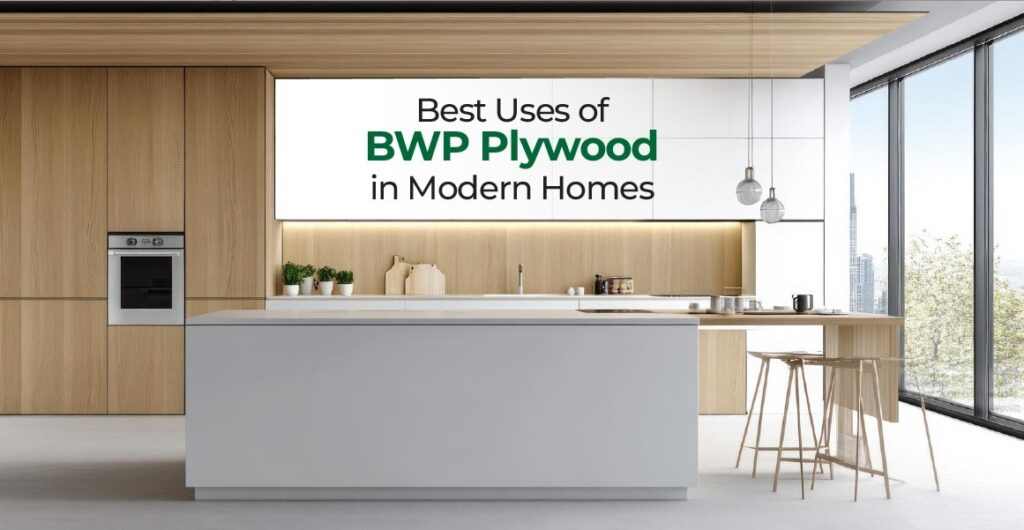
In modern homes, material choices are expected to balance durability, aesthetics, and long-term reliability. Among these, BWP plywood has steadily become a preferred option, especially in spaces where moisture is part of everyday use.
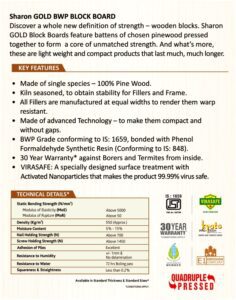
BWP, or Boiling Water Proof plywood, is commonly grouped under waterproof plywoods. It is manufactured using phenol-formaldehyde adhesives and tested as per IS 710 standards. These tests are designed to check how well the bonding holds under prolonged exposure to water.
Having said that, choosing BWP plywood is not just about reading the label. Its real value comes from how and where it is used. Performance depends just as much on application, handling, and installation as it does on manufacturing quality.
BWP plywood is engineered to handle high moisture conditions without significant loss of bonding strength. The phenolic resin used in its construction creates a stable internal structure that resists water penetration better than standard grades.
In practical use, this translates to fewer issues like swelling, layer separation, or structural weakening in humid environments.
Simultaneously, it is important to keep expectations realistic. BWP plywood behaves like any engineered wood product. It responds to climate, handling, and finishing. Waterproof does not mean it can be left unprotected or poorly installed.
This is where material understanding becomes important.
Kitchens are among the most demanding areas in any home. Steam, oil vapours, and regular cleaning create a constantly changing environment.
BWP plywood is widely used for kitchen cabinets, especially in base units and under-sink areas. These sections are more exposed to moisture due to plumbing and daily usage.
In practical use, BWP plywood tends to hold its shape better than lower grades. It reduces the chances of edges swelling or panels losing alignment over time.
However, this does not eliminate the need for proper finishing. Edge sealing, laminates, and careful installation still play a key role in ensuring long-term performance.
Bathrooms combine high humidity with direct water exposure, which makes them particularly challenging for interior materials.
BWP plywood is commonly used for vanity units, mirror cabinets, and storage sections in these spaces. Its resistance to moisture makes it a more dependable option compared to MR or even BWR grades.
Over time, this becomes visible in the way shutters continue to align properly and surfaces remain stable.
That said, constant water stagnation or poor ventilation can still create problems. Good design that allows airflow and prevents water accumulation makes a noticeable difference.
Utility spaces often see more water exposure than any other part of the home. Washing machines, dish washing areas, and cleaning zones all contribute to frequent moisture contact.
BWP plywood works well for cabinets and storage units in these areas. It can handle repeated exposure without showing early signs of deterioration.
In many homes, this is an area where material selection is overlooked. Standard plywood may seem adequate at first, but over time, replacement becomes necessary.
Choosing the right grade at the beginning helps avoid that cycle.
Balconies, covered terraces, and semi-open areas are exposed to humidity, occasional rain, and temperature changes.
BWP plywood can be used in these spaces when combined with appropriate finishes. Laminates or protective coatings help reduce direct exposure and extend durability.
This is where material choice needs clarity. While BWP plywood performs better than standard grades, it is not designed for fully outdoor use. Understanding these limits helps avoid long-term issues.
In coastal areas and regions with consistently high humidity, even indoor spaces experience moisture-related challenges.
BWP plywood is often preferred for modular furniture in such conditions. Wardrobes, cabinets, and storage units made with BWP tend to remain more stable over time.
Issues like panel distortion or joint loosening are less frequent when the right material is used.
However, one practical detail often gets missed. Storage before installation matters. If plywood absorbs moisture at the site, it can affect how it performs later.
Doors and partitions in areas like kitchens, bathrooms, and basements are exposed to fluctuating humidity levels.
Using BWP plywood in these applications helps maintain structural stability. Doors tend to operate smoothly, and surface finishes remain intact for longer periods.
In practical use, this reduces the need for frequent adjustments.
Simultaneously, thickness selection and framing should not be overlooked. Even high-quality plywood depends on proper support.
A common assumption is that BWP plywood does not need any additional protection. In reality, finishes and edge sealing remain essential.
Waterproof plywoods offer stronger bonding resistance, but they are not immune to prolonged exposure or poor workmanship.
Another misconception is that maintenance is no longer required. Regular checks, especially in wet areas, help catch early signs of wear before they become major issues.
Clear expectations always lead to better results.
The performance of BWP plywood depends on several factors working together.
Core quality and veneer selection influence how the board behaves under stress. Manufacturing consistency ensures that bonding remains reliable. Certifications such as IS 710 indicate adherence to tested standards.
At the same time, carpentry skill plays an equally important role. Accurate cutting, proper joinery, and correct sealing techniques directly affect durability.
Environmental conditions also matter. Ventilation, humidity levels, and exposure to water continue to influence performance over time.
BWP plywood is best used where moisture exposure is frequent or unavoidable. Kitchens, bathrooms, utility areas, and high-humidity interiors are where it delivers the most value.
At the same time, not every application requires BWP grade. Using it selectively ensures a balance between performance and cost.
With years of experience across varied Indian conditions, SharonPly has seen a consistent pattern. The right results come not from using the highest grade everywhere, but from using the right material in the right place. When that decision is made carefully, interiors remain stable, functional, and dependable for years.





Users understand that SHARONPLY is committed to protecting the User’s privacy and shall take all efforts to protect any personal data provided to the Website by reasonable security safeguards against such risks as loss or unauthorised use, destruction, modification or disclosure of data, However, in case of any lapse, SHARONPLY shall not be held responsible for any effect or consequences thereof. The Website uses cookies to track usage of the path of the User. Since most web browsers automatically accept cookies, User can edit User’s browser options to block them if User does not want the Website to use cookies to track usage of the path of the User.
SHARONPLY undertakes not to disclose, except as otherwise provided, the personal information provided by the User to any person, unless such action is necessary to: –
By filling up any form on the Website User automatically grants SHARONPLY a royalty-free, perpetual, irrevocable non-exclusive license to use, reproduce, publish, edit, distribute, and publicly display the information given in the form and to sublicense such rights.
Any queries regarding the SHARONPLY’s privacy policy, may be sent to admin@sharonply.com.