
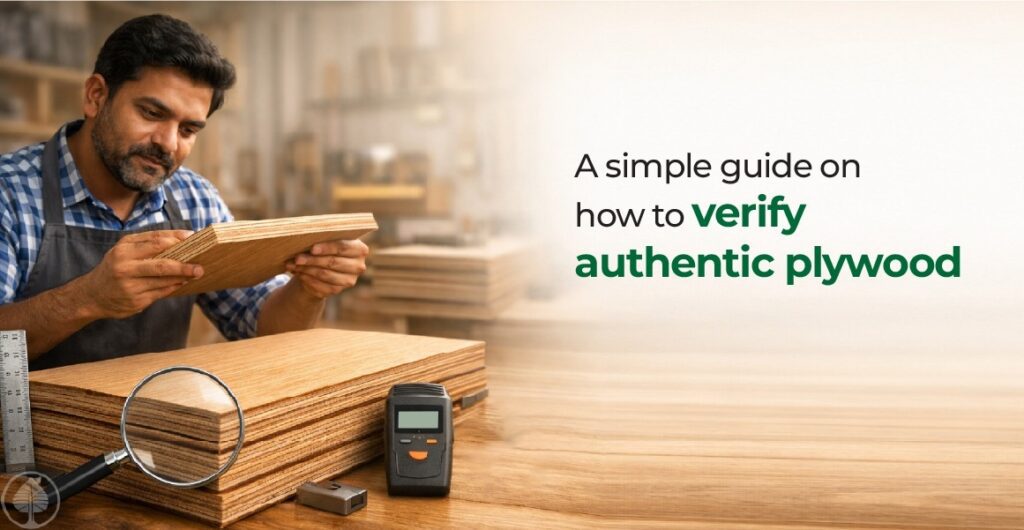
In today’s market, plywood is widely available in different grades, price points and quality levels. For homeowners and professionals alike, one of the most common concerns is whether the plywood being used is truly authentic.
Externally most plywood sheets look similar. The real difference lies inside the board, in the core construction, bonding quality and manufacturing consistency. These are not always visible at the time of purchase.
This is where a basic understanding of how to verify plywood becomes useful. It helps avoid long-term issues that often appear only after installation.
Authentic plywood is manufactured under controlled conditions, using standardized processes and tested bonding systems. This ensures predictable performance in terms of strength, moisture resistance and durability.
Non-certified or substandard plywood may look similar but often lacks consistent bonding or core quality. Over time, this becomes noticeable in the form of swelling, bending or layer separation.
In practical use, the difference shows up in how well the material holds up under daily conditions.
One of the most reliable ways to verify plywood is by checking for certification marks.
In India, plywood is commonly tested under standards such as IS 303 for BWR grade and IS 710 for BWP grade. Authentic plywood usually carries an ISI mark along with details of the grade, thickness and manufacturer.
This marking is typically stamped on the surface of the board.
However, markings alone should not be the only factor. In some cases, counterfeit stamps may be used. It is always better to cross-check with trusted suppliers or verify the source of purchase.
Many buyers assume that all plywood labeled as waterproof performs the same. This is not accurate.
MR grade plywood is designed for low-moisture interiors. BWR and BWP grades offer higher resistance due to stronger adhesive bonding. Among these, BWP is commonly associated with waterproof plywoods used in kitchens and bathrooms.
Verifying authenticity also means ensuring that the grade mentioned matches the intended application.
If a product is priced unusually low for a BWP grade, it is worth taking a closer look.
The internal structure of plywood plays a key role in its performance.
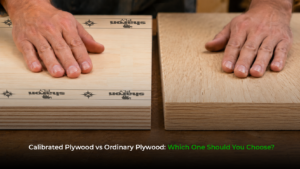
When possible, check the edges of the board. A good quality plywood sheet will have evenly arranged veneers without large gaps or overlaps. The layers should appear compact and consistent.
In lower quality boards, visible voids or uneven layers can be seen along the edges. These gaps tend to trap moisture and weaken the structure over time.
This is where material quality becomes visible, even without technical testing.
Surface finish gives an early indication of manufacturing quality.
Authentic plywood generally has a smooth, even surface without patches or excessive repairs. Minor variations are normal, but large filled sections may indicate lower-grade veneers.
Density is another useful indicator. When lifted, good quality plywood feels solid and balanced. Extremely lightweight boards may indicate thinner or lower-density core layers.
In practical use, this difference affects load-bearing capacity and long-term stability.
Experienced carpenters often rely on basic checks before using plywood.
One common method is the sound test. Tapping the board lightly should produce a uniform sound. Hollow or inconsistent sounds may indicate internal gaps.
Another check is cutting a small section to observe the internal layers. This is not always possible during purchase, but it is a reliable way to assess quality on site.
These simple practices often reveal more than surface inspection alone.
Authentic waterproof plywoods are designed to resist moisture at the bonding level. However, this cannot always be verified visually.
Some suppliers demonstrate boiling water or soak tests, especially for BWP grade plywood. While these tests indicate bonding strength, they should be seen as supporting checks rather than the only proof of authenticity.
In actual use, moisture resistance also depends on edge sealing, finishing and installation quality.
Price can offer useful signals, though it should not be the only deciding factor.
High-quality plywood involves better raw materials, controlled manufacturing and tested adhesives. These factors influence cost.
If a product is significantly cheaper than the typical market range for a given grade, it may indicate compromises in core quality or bonding.
Simultaneously, a higher price does not always guarantee better quality. The key is to balance cost with verifiable features.
Even authentic plywood can under-perform if not handled correctly.
Sheets should be stored in dry, well-ventilated areas and kept away from direct contact with damp floors. Exposure to moisture before installation affects dimensional stability.
In practical use, this becomes noticeable when panels warp or edges swell soon after fixing.
Proper handling ensures that the original quality of the plywood is maintained.
One common misconception is that a branded label alone guarantees authenticity. While brand reputation helps, verification should still include checking certification, core quality and supplier reliability.
Another assumption is that thicker plywood is always better. Thickness contributes to strength, but core quality and bonding are equally important.
There is also a belief that waterproof plywoods do not require any finishing. In reality, laminates and edge sealing are essential to protect surfaces from prolonged exposure.
Understanding these points helps in making more informed choices.
Verifying authentic plywood is not about a single test or feature. It involves a combination of checks that together indicate quality.
Certification marks, core inspection, surface finish, density and supplier credibility all play a role. When these factors align, the chances of long-term performance improve significantly.
With years of experience across diverse applications and climates, SharonPly has seen that informed selection at the purchase stage prevents most issues later. When authenticity is verified carefully, plywood performs as expected and supports interiors that remain stable and reliable over time.







Users understand that SHARONPLY is committed to protecting the User’s privacy and shall take all efforts to protect any personal data provided to the Website by reasonable security safeguards against such risks as loss or unauthorised use, destruction, modification or disclosure of data, However, in case of any lapse, SHARONPLY shall not be held responsible for any effect or consequences thereof. The Website uses cookies to track usage of the path of the User. Since most web browsers automatically accept cookies, User can edit User’s browser options to block them if User does not want the Website to use cookies to track usage of the path of the User.
SHARONPLY undertakes not to disclose, except as otherwise provided, the personal information provided by the User to any person, unless such action is necessary to: –
By filling up any form on the Website User automatically grants SHARONPLY a royalty-free, perpetual, irrevocable non-exclusive license to use, reproduce, publish, edit, distribute, and publicly display the information given in the form and to sublicense such rights.
Any queries regarding the SHARONPLY’s privacy policy, may be sent to admin@sharonply.com.