
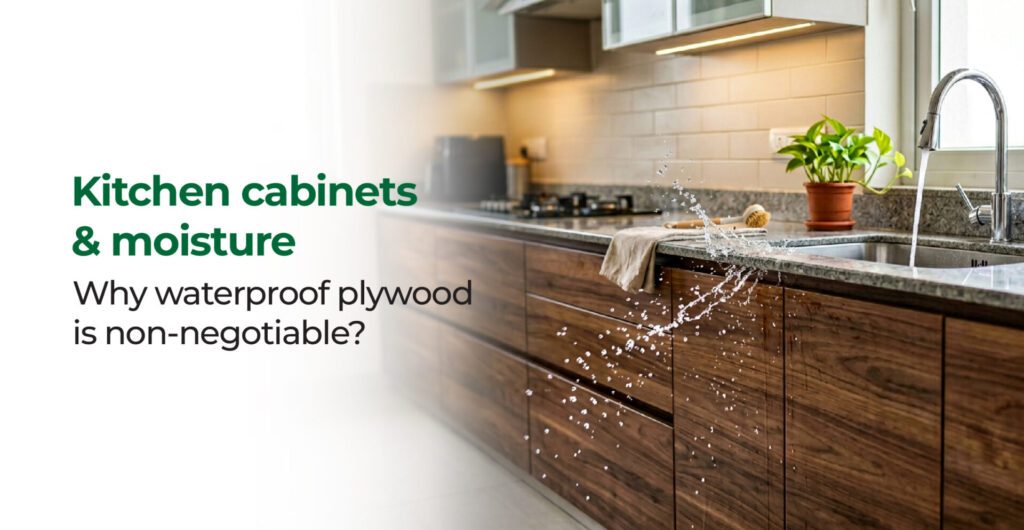
The kitchen is one of the most demanding areas in a house.
There is constant exposure to steam, water splashes, cooking heat, and cleaning chemicals. In the Indian context, there is also humidity, monsoons, and varying ventilation levels. This takes a toll on all materials used inside kitchen cabinets.
This is where the choice of material becomes important.
When it comes to cabinet carcasses, shelves, and sink units, waterproof plywood is no longer a luxury item.
In most instances, it is a necessity.
Many people assume moisture in kitchens comes only from visible water. That is not accurate. Moisture builds up in three ways:
In coastal cities, ambient humidity remains high for most of the year. Even in dry regions, indoor moisture can accumulate if ventilation is limited.
In practical use, cabinet interiors rarely stay completely dry. The area below the sink is particularly vulnerable. Minor leaks often go unnoticed for weeks.
Over time, this becomes noticeable. Panels swell. Laminates bubble. Edges chip. Hinges loosen.
The base material decides whether this damage remains superficial or becomes structural.
Not all plywood is the same.
MR grade plywood, often called moisture resistant plywood, uses urea formaldehyde resin. It performs well in dry interior conditions such as wardrobes or bedroom furniture.
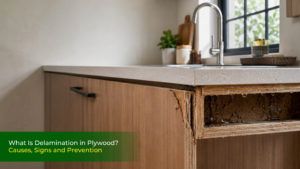
However, MR grade is not designed for prolonged or repeated exposure to water. If subjected to continuous dampness, the bonding between veneers can weaken. Delamination may occur.
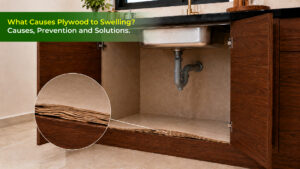
Swelling at edges is another common issue. Once moisture enters through unsealed edges or screw holes, the internal layers can expand unevenly.
In kitchen environments, especially around sinks and dishwashers, MR grade becomes a risk.
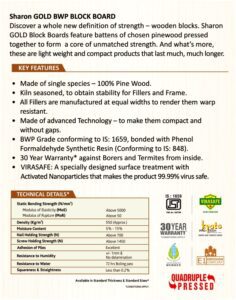
Waterproof plywoods, typically classified as BWP or marine grade under IS 710 standards, use phenol formaldehyde resin as the bonding agent.
This resin forms a highly durable bond under high temperature and pressure. It is resistant to boiling water conditions during testing. Under IS 710, samples are subjected to cyclic boiling and drying to evaluate bond integrity.
The difference lies in the adhesive chemistry and pressing parameters. The veneers are bonded in a way that reduces the chance of separation even under prolonged moisture exposure.
It is important to clarify something here. Waterproof does not mean immune to damage. It means the bond line resists failure under water exposure far better than standard grades.
Proper sealing and installation still matter.
Bonding is only one part of the equation.
Core construction determines how well the board holds screws and resists warping. High-quality waterproof plywood uses well-jointed hardwood or selected plantation veneers with minimal core gaps.
In practical use, this affects hinge performance and shelf stability. Kitchen shutters are opened and closed multiple times every day. The weight of utensils and appliances adds load.
If the core is weak or uneven, screws may loosen faster, especially in humid conditions.
This is where many cost-driven substitutions fail. On the surface, the cabinet may look similar. Internally, the performance differs significantly.
If there is one area where waterproof plywood is non-negotiable, it is the sink cabinet.
Plumbing joints, RO systems and cleaning activities create constant moisture exposure. Even a small leak can soak the base panel.
In such areas, using MR grade or low-quality boards often leads to swelling within a year or two.
Professional interior contractors across India typically specify BWP grade plywood for sink bases and lower cabinets. This is not over-specification. It is based on site experience.
Replacing a damaged sink unit later is far more expensive than selecting the right material at the beginning.
Performance depends on region.
In cities like Chennai or Mumbai, humidity levels remain high for most of the year. In hill stations, temperature variation adds another layer of stress. In northern regions, seasonal shifts from dry winters to humid monsoons cause expansion and contraction cycles.
Waterproof plywoods handle these fluctuations better due to stronger bonding and structural stability.
However, storage on site is equally important. Boards stacked directly on damp floors or exposed to rain before installation can absorb moisture prematurely.
Even the best plywood should be stored on raised platforms and covered properly until use.
For kitchen cabinet carcasses, 16 mm to 19 mm thickness is commonly used. Thicker boards offer better load-bearing capacity and reduced deflection over longer spans.
Shelves that carry heavy utensils or appliances should not rely solely on material strength. Span length and support placement matter.
In practical use, proper design works together with material selection.
Waterproof plywood is not a substitute for poor structural planning. It complements good design.
Modern kitchens are often compact and enclosed.
Using low-emission waterproof plywood that complies with E1 or similar formaldehyde standards improves indoor air quality. Adhesive systems used in BWP grade boards can also be engineered to meet emission norms.
While moisture resistance is the primary concern in kitchens, indoor air safety is an added consideration, especially in apartments with limited ventilation.
Material choice should address both durability and health.
Waterproof plywoods typically cost more than MR grade boards.
For dry upper cabinets away from water sources, some projects may selectively use MR grade to manage budgets. However, this should be a conscious decision based on exposure level.
For base cabinets, sink units and areas near cooking zones, the cost difference is often justified by reduced repair risk.
Over time, this becomes noticeable in maintenance savings. Swollen boards, re-lamination and hinge replacements add up.
Balanced specification is always better than blanket upgrading or aggressive cost cutting.
Even high-grade waterproof plywood can underperform if edges are left unsealed.
All cut edges in kitchens should be properly edge banded or sealed. Screw holes should be tight and accurate. Silicone sealing around sinks helps prevent water seepage.
Carpentry skill levels vary across sites. Clear supervision and correct installation practices are essential.
Material strength supports durability. Workmanship completes it.
Kitchen cabinets operate in one of the harshest indoor environments.
Moisture is constant. Leaks are unpredictable. Humidity varies across regions. Daily usage is high.
In such conditions, waterproof plywood is not about premium positioning. It is about practical risk management.
Choosing BWP grade boards for moisture-prone areas significantly improves structural reliability and long-term stability. Combined with proper storage, careful installation and realistic load planning, it forms the foundation of a durable kitchen.
At SharonPly, after decades of observing how plywood performs across Indian homes and project sites, one lesson stands clear. Kitchens demand respect for moisture. When waterproof plywood is specified thoughtfully, it protects not just cabinets, but the investment behind them.





Users understand that SHARONPLY is committed to protecting the User’s privacy and shall take all efforts to protect any personal data provided to the Website by reasonable security safeguards against such risks as loss or unauthorised use, destruction, modification or disclosure of data, However, in case of any lapse, SHARONPLY shall not be held responsible for any effect or consequences thereof. The Website uses cookies to track usage of the path of the User. Since most web browsers automatically accept cookies, User can edit User’s browser options to block them if User does not want the Website to use cookies to track usage of the path of the User.
SHARONPLY undertakes not to disclose, except as otherwise provided, the personal information provided by the User to any person, unless such action is necessary to: –
By filling up any form on the Website User automatically grants SHARONPLY a royalty-free, perpetual, irrevocable non-exclusive license to use, reproduce, publish, edit, distribute, and publicly display the information given in the form and to sublicense such rights.
Any queries regarding the SHARONPLY’s privacy policy, may be sent to admin@sharonply.com.