

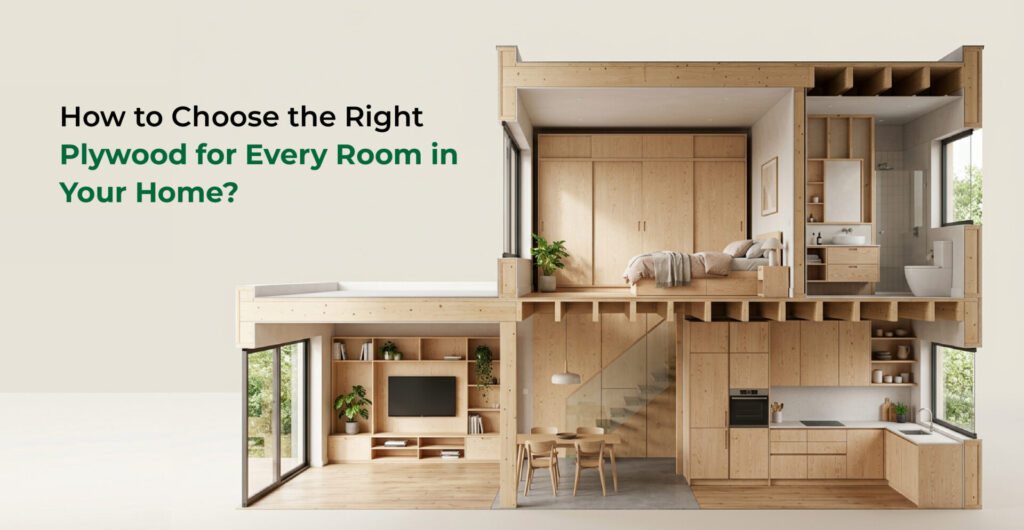
Choosing plywood for a home is rarely a one-size-fits-all decision. Each room has different conditions, usage patterns and exposure to moisture. What works well in a bedroom may not perform the same way in a kitchen or bathroom.
Often, issues with interiors do not come from design or finishing. They begin with the wrong material choice at the base level. This is why understanding how plywood behaves in different environments becomes important.
This guide looks at how to select the right plywood for each room, based on practical use, climate conditions and construction realities in Indian homes.
Before looking at room-wise selection, it helps to understand how plywood is classified.
MR grade plywood is designed for dry areas with minimal moisture exposure. BWR grade plywood offers better resistance and is suitable for areas with moderate humidity. BWP grade plywood, often referred to as waterproof plywoods, is manufactured using phenolic resins and tested under IS 710 standards for high moisture resistance.
These grades define bonding strength, not just surface behaviour. Choosing the right grade depends on how much moisture the material is likely to face over time.
Living rooms are typically low-moisture environments. However, they see frequent use and often support heavy furniture and wall units.
MR grade plywood can be used for TV units, shelving and decorative panels when the area is well-ventilated. For larger units or load-bearing sections, BWR grade plywood provides added stability.
In practical use, thickness and core quality play a bigger role here than moisture resistance. Over time, poor-quality cores may lead to sagging shelves or uneven surfaces.
Bedrooms are relatively stable environments with limited exposure to moisture. Wardrobes, bed frames and study units are the main applications.
MR grade plywood is commonly used for these interiors. However, in regions with high humidity, BWR grade plywood offers better long-term stability.
This is where climate plays a role. In coastal areas, even bedrooms can experience moisture-related issues over time.
Proper edge sealing and finishing also contribute to durability, especially inside wardrobes where airflow is limited.
Kitchens require more careful material selection. Steam, heat and regular cleaning create a challenging environment.
BWR grade plywood is widely used for kitchen cabinets and overhead units. For base cabinets and under-sink areas, BWP plywood is often preferred due to higher moisture exposure.
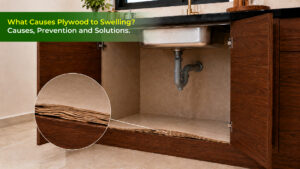
In practical use, the difference becomes visible over time. Lower grades may show edge swelling or surface distortion near sinks and plumbing zones.
This is where material choice matters. Using higher-grade plywood selectively in critical areas improves performance without increasing overall cost significantly.
Bathrooms are high-moisture environments with direct water exposure. Standard plywood grades tend to under perform in these conditions.
BWP plywood is commonly used for vanity units, storage cabinets and partitions in bathrooms. Its bonding strength helps maintain structural integrity even under continuous humidity.
However, proper finishing remains essential. Laminates, sealants and good ventilation reduce the impact of prolonged moisture.
Over time, this combination ensures better performance and fewer maintenance issues.
Utility rooms often combine water usage with limited ventilation. Washing machines, dish washing areas and cleaning zones create constant moisture exposure.
BWP plywood is suitable for cabinets and storage units in these areas. It handles repeated exposure better than MR or BWR grades.
In many homes, these spaces are overlooked during planning. Using lower-grade materials here often leads to early replacement.
Choosing the right plywood at the beginning helps avoid that cycle.
Study rooms and home offices require stable and durable surfaces rather than high moisture resistance.
MR grade plywood is generally sufficient for desks, shelves and storage units in these spaces. For larger installations or wall-mounted units, BWR grade may be considered for added strength.
In practical use, surface finish and load-bearing capacity are more relevant than moisture resistance.
Flush doors and partitions connect different environments within the home. Their performance depends on both usage and exposure.
For general interior doors, BWR grade plywood provides a good balance of strength and durability. In areas close to bathrooms or kitchens, BWP plywood may be used for better moisture resistance.
Over time, this becomes noticeable in how well doors retain alignment and finish.
Frame quality and installation also influence performance significantly.
Choosing plywood based on room alone is not enough. Several other factors influence long-term performance.
Core quality affects strength and resistance to internal stress. Bonding consistency determines how well the layers hold under moisture. Certifications such as IS 303 and IS 710 indicate adherence to tested standards.
Handling and storage on site also matter. Plywood exposed to damp conditions before installation may show early signs of distortion.
Carpentry skill plays a key role as well. Proper cutting, joinery and sealing ensure that the material performs as intended.
A common belief is that waterproof plywood should be used everywhere. While it offers higher resistance, it is not necessary for all areas.
Using BWP plywood selectively ensures better cost efficiency without compromising performance.
Another misconception is that thickness alone determines strength. In reality, core construction and bonding quality are equally important.
Understanding these aspects helps in making more balanced decisions.
Selecting plywood for each room is about matching the material to actual conditions. Moisture levels, usage patterns and ventilation all influence performance.
Living rooms and bedrooms may not need high moisture resistance, but kitchens, bathrooms and utility areas do. Within these spaces, critical zones such as under-sink cabinets require additional attention.
With years of experience across diverse applications, SharonPly has seen that well-informed choices at the planning stage lead to interiors that remain stable and dependable. When plywood is selected with clarity and used appropriately, it supports both function and longevity across every room in the home.






Users understand that SHARONPLY is committed to protecting the User’s privacy and shall take all efforts to protect any personal data provided to the Website by reasonable security safeguards against such risks as loss or unauthorised use, destruction, modification or disclosure of data, However, in case of any lapse, SHARONPLY shall not be held responsible for any effect or consequences thereof. The Website uses cookies to track usage of the path of the User. Since most web browsers automatically accept cookies, User can edit User’s browser options to block them if User does not want the Website to use cookies to track usage of the path of the User.
SHARONPLY undertakes not to disclose, except as otherwise provided, the personal information provided by the User to any person, unless such action is necessary to: –
By filling up any form on the Website User automatically grants SHARONPLY a royalty-free, perpetual, irrevocable non-exclusive license to use, reproduce, publish, edit, distribute, and publicly display the information given in the form and to sublicense such rights.
Any queries regarding the SHARONPLY’s privacy policy, may be sent to admin@sharonply.com.